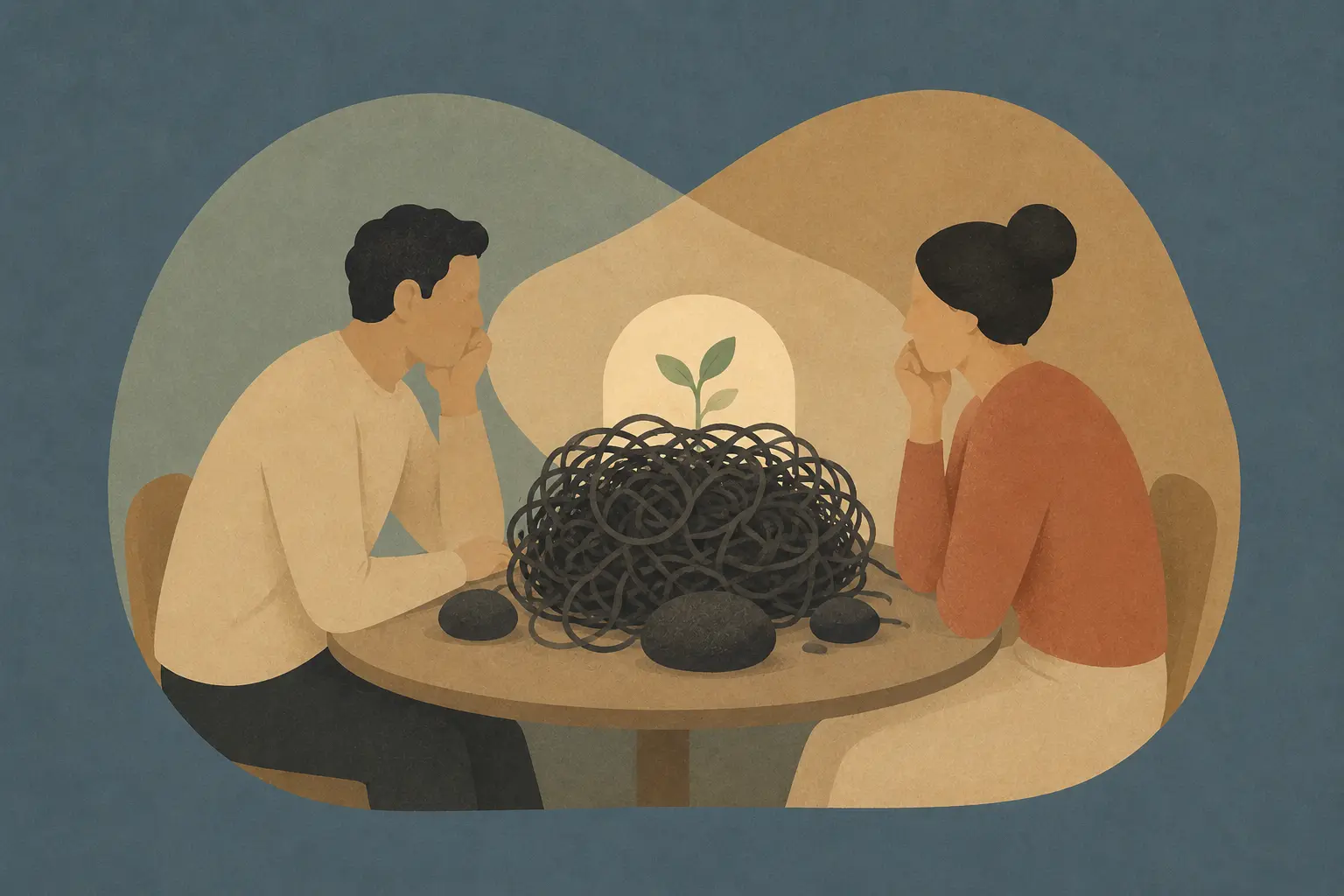
After the children fall asleep, they sit at the table. They want to improve their relationship. Within minutes, however, last week’s argument, money, housework, and something said months ago are all on the table too. Two hours later, both are exhausted. They believe they have worked on the relationship, yet feel further apart.
When a relationship is struggling, discussing problems is necessary. But when improving it becomes nothing but examining difficulties, a shared life can feel like an endless record of faults. Conversation increases without a corresponding increase in trust, play, appreciation, or curiosity.
Why does the mind focus on what is wrong?
Threats and errors can capture attention faster than positive experiences. This serves a protective everyday function: noticing what is wrong helps us prepare for danger. In a relationship, however, the same tendency can lead us to pick out what is missing among dozens of ordinary, reassuring things a partner does.
This is not simply “negative thinking.” When a problem recurs, paying attention to it is understandable. But when every interaction becomes evidence of the problem, new and positive information cannot enter the relationship’s story. A partner’s effort becomes “what they should be doing anyway,” while a mistake reveals “their true character.”
Good experiences do not automatically become part of the relationship
Shelly Gable and colleagues studied how people share good news with partners and the responses they receive. Their findings showed the importance of enthusiastic, engaged responses to positive events for closeness and relationship well-being. Something good happening may not be enough on its own; the couple also needs to notice and amplify it together.
When a partner describes a small success at work, putting down the phone, asking for details, and joining in their pleasure may seem minor. Yet these moments communicate “Your world matters to me.” While problem conversations seek to understand damage, positive responses remind us why the bond is worth protecting.
The cost of turning a relationship into a project
Some couples turn every time together into a progress meeting once they begin seeking help. They read books, take tests, and conduct weekly reviews. All of these may be useful. But if the relationship becomes a project that always needs work, two people can lose the ability to simply feel at ease together.
Intimacy consists of more than correct communication techniques. Laughing, sharing an ordinary detail, sitting quietly, and connecting without producing a solution are also part of it. When the language of problems occupies all of life, a couple begins constantly measuring the relationship instead of living it.
Giving problem conversations a boundary
The suggestion here is not to think positively or cover up serious matters. Infidelity, violence, addiction, financial irresponsibility, or persistent humiliation cannot be balanced out by recalling a few pleasant moments. Some problems require clear decisions and professional support.
For more ordinary, recurring conflicts, it may help to set limits around a conversation. Agree on the topic, the small outcome you hope to reach, and the time available. Every disagreement does not have to explain the entire history of the relationship.
A couple can also ask:
- What went well between us this week that we failed to notice?
- What small thing did my partner do that I took for granted?
- How much of our recent talking was about understanding the problem, and how much about proving each other wrong?
These questions expand the information available about the relationship rather than manufacturing optimism. Couples who look only at problems cannot see their sources of strength. Couples who look only at the good lose contact with reality.
Every problem need not be solved before leaving the table. Sometimes protecting the relationship means placing another truth beside the difficulty: “We are struggling, but we are more than the moments in which we struggle.”
References
- Algoe, S. B. (2012). Find, remind, and bind: The functions of gratitude in everyday relationships. Social and Personality Psychology Compass, 6(6), 455–469. https://doi.org/10.1111/j.1751-9004.2012.00439.x
- Gable, S. L., Reis, H. T., Impett, E. A., & Asher, E. R. (2004). What do you do when things go right? The intrapersonal and interpersonal benefits of sharing positive events. Journal of Personality and Social Psychology, 87(2), 228–245. https://doi.org/10.1037/0022-3514.87.2.228
- Johnson, M. D., Lavner, J. A., Mund, M., Zemp, M., Stanley, S. M., Neyer, F. J., Impett, E. A., Rhoades, G. K., Bodenmann, G., Weidmann, R., Bühler, J. L., Burriss, R. P., Wünsche, J., & Grob, A. (2022). Within-couple associations between communication and relationship satisfaction over time. Personality and Social Psychology Bulletin, 48(4), 534–549. https://doi.org/10.1177/01461672211016920