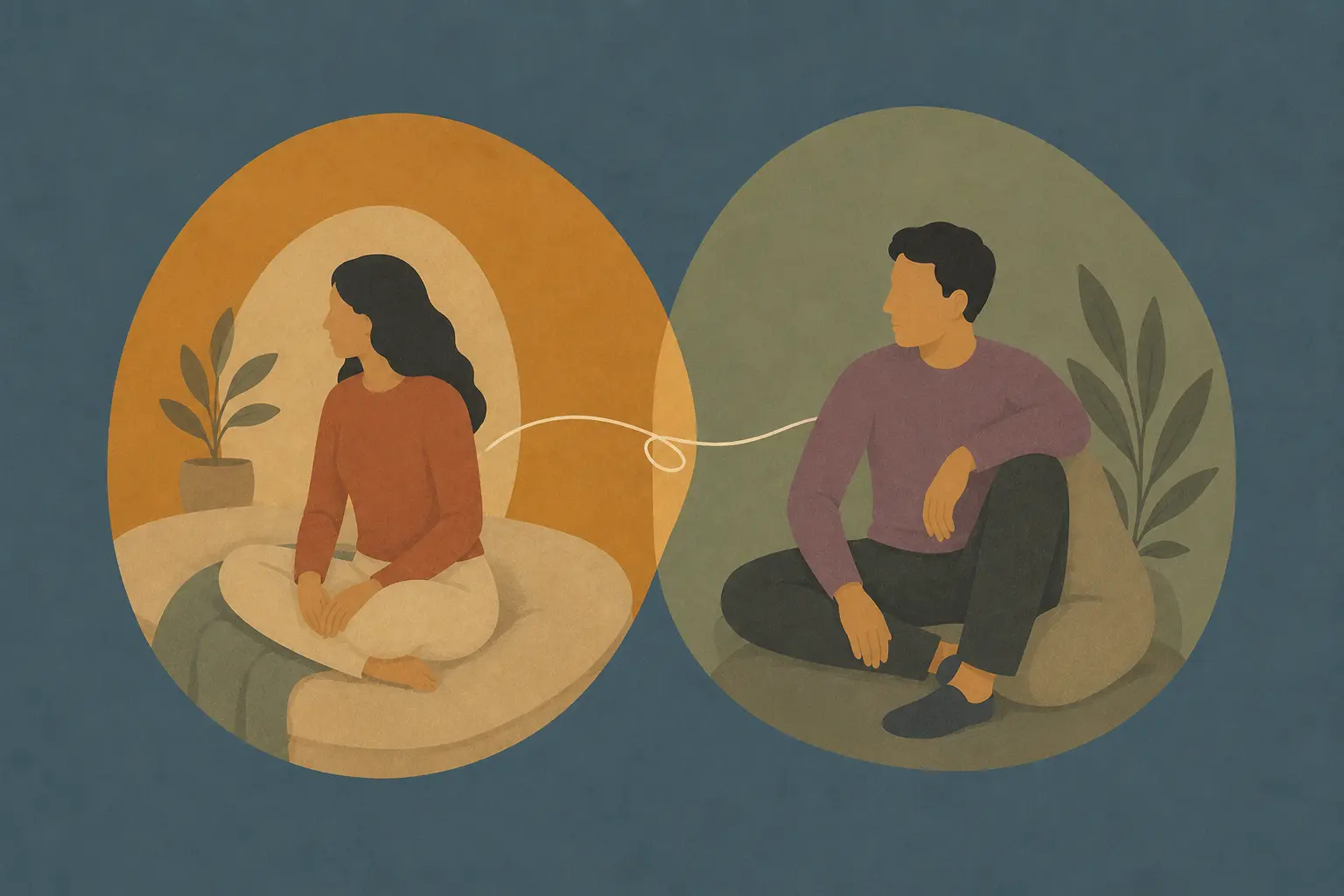
Coming out of the bathroom, they notice an image left open on their partner’s phone. Their first thought is not about the act, but about their own inadequacy: “Why do they need this when they have me?” When they raise it, the other person feels ashamed and defensive. Within minutes, masturbation has become evidence used to measure the relationship’s worth, rather than a private bodily experience.
There is no single answer to what masturbation means within a relationship. For some, it is a way to know their body, relax, or find quick sexual release. For others, it may be an alternative to partnered sex, or a different sexual experience that exists alongside it. The behavior alone is not a reliable indicator of distance. Meaning develops through motivation, secrecy, frequency, the couple’s sexual context, and the values both people attach to it.
Individual sexuality does not end when a relationship begins
Entering a relationship does not automatically remove a person’s private relationship with their own body. Partnered sexuality involves encounter, reciprocity, and two people’s rhythms. Masturbation is different: the individual directs timing, pace, and imagination. Because they do not necessarily meet the same need, one is not an inadequate or defective copy of the other.
Large-sample studies suggest that the relationship between masturbation and partnered sex is not simple. In some groups, one increases as the other decreases; in others, they rise together. People do not masturbate only because partnered sex is unavailable. Pleasure, falling asleep, managing stress, self-exploration, and releasing sexual tension are among the reasons.
“If there is masturbation, something is missing in the relationship” is therefore too simplistic scientifically and psychologically. But the opposite is incomplete too: “It’s entirely personal and has nothing to do with the partner” may overlook the couple’s shared life.
Sometimes comparison is what hurts
Learning that a partner masturbates can prompt immediate comparison: “They don’t find me attractive enough,” “They want the bodies on the screen more than mine,” or “They’re choosing the easy option over making an effort with me.” Such interpretations can become stronger when the couple’s sexual closeness has declined.
That hurt should not be minimized. If one person repeatedly seeks intimacy and the other consistently avoids it while regularly engaging in solo sexuality, the couple may indeed need to discuss their sexual life. Still, “I feel left out of our sex life” is likely to reveal more than the verdict “Your masturbation is a betrayal.”
Privacy and secrecy are different
Having sexual privacy is natural. Reporting every fantasy, thought, or individual behavior can create surveillance rather than intimacy. On the other hand, a pattern that violates agreements, depends on lies, or markedly affects partnered intimacy cannot simply be dismissed as “private.”
The useful question is not whether masturbation is universally right or wrong, but how this couple draws the boundary between privacy and shared responsibility. Is pornography involved? How does each person feel about it? Does the behavior replace partnered sexuality or coexist with it? Does avoidance of the conversation reflect privacy, shame, or a breached agreement?
Better questions to ask
Trying to understand the experience rather than demanding an accounting can help both people become less defensive:
- What need does this mostly meet for you?
- Is there something missing or pressured in our sex life?
- What do we want to keep personal, and what do we want to discuss together?
- Which boundaries would help both of us feel safe about this?
The purpose is not to incorporate masturbation into the relationship or prohibit it, but to make its meaning visible. Sometimes it reflects a longstanding, harmless relationship with one’s own body. Sometimes solo sexuality has become a place where unspoken distance quietly settles.
Masturbation alone does not tell us how close a couple is. More revealing is how honestly and freely they can discuss differences in desire, hurt feelings, and the boundaries of privacy.
References
- Fischer, N., & Træen, B. (2022). A seemingly paradoxical relationship between masturbation frequency and sexual satisfaction. Archives of Sexual Behavior, 51(6), 3151–3167. https://doi.org/10.1007/s10508-022-02305-8
- Herbenick, D., Fu, T.-C., Wasata, R., & Coleman, E. (2023). Masturbation prevalence, frequency, reasons, and associations with partnered sex in the midst of the COVID-19 pandemic: Findings from a U.S. nationally representative survey. Archives of Sexual Behavior, 52(3), 1317–1331. https://doi.org/10.1007/s10508-022-02505-2
- Regnerus, M., Price, J., & Gordon, D. (2017). Masturbation and partnered sex: Substitutes or complements? Archives of Sexual Behavior, 46, 2111–2121. https://doi.org/10.1007/s10508-017-0975-8