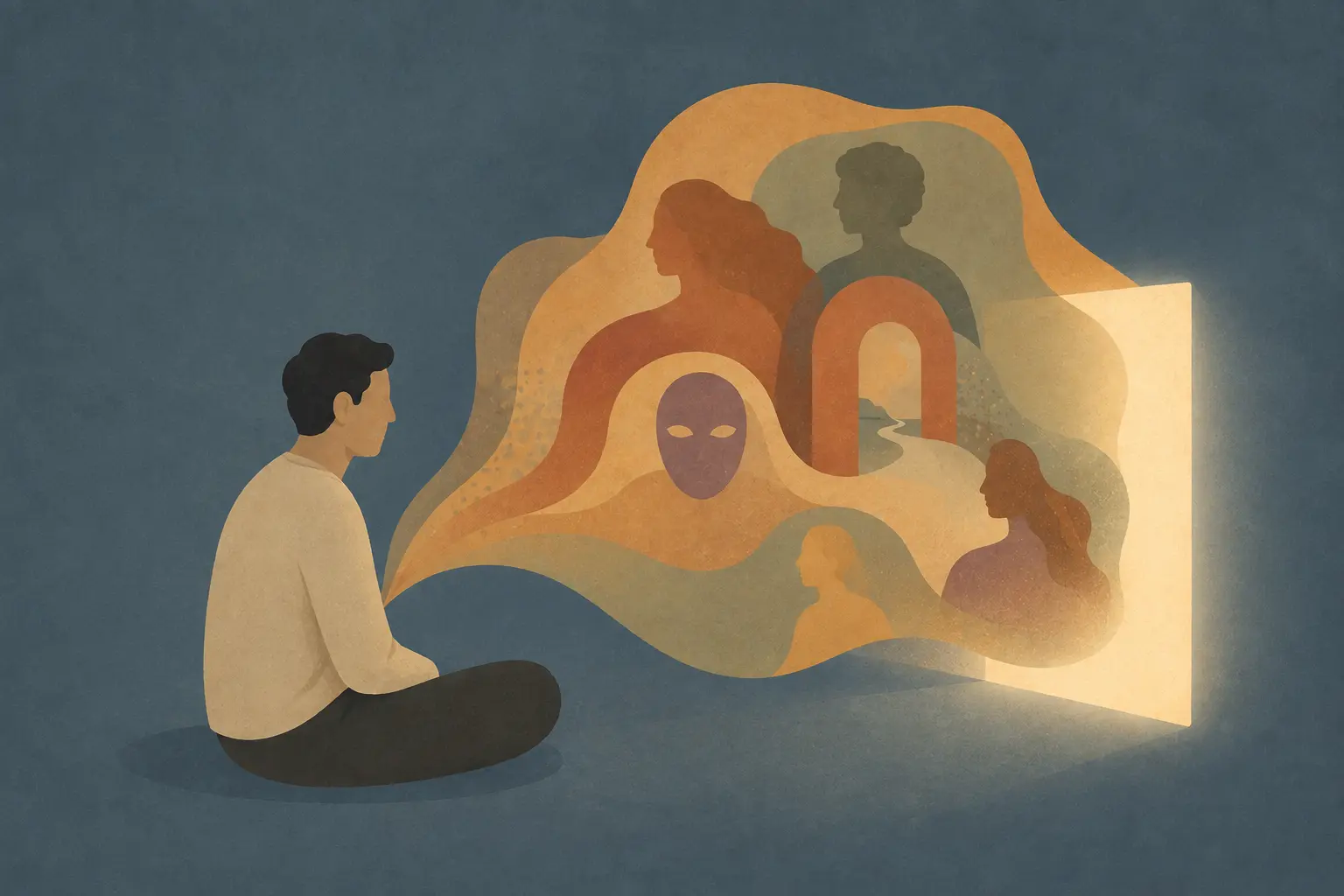
After everyone is asleep, they open a video on their phone. It catches their interest; their body responds. Afterward, curiosity gives way to unease: “If I watched this, I must want it in real life.” Sometimes the question becomes heavier: “What does this say about who I am?”
With pornography, people often equate what they watch directly with what they want in life. Yet finding an image arousing does not mean wanting the scene to happen, finding it consistent with our values, or believing it would be good for us. What we watch may offer a clue, but it is not, by itself, a confession.
Arousal, desire, and choice are different things
Sexual experience involves at least three layers: the body’s response to a stimulus, what a person subjectively desires, and what they want to choose in real life. Sometimes these overlap; sometimes they diverge. A scene may produce physical arousal while the person has no wish to bring it into their life.
This distinction is not unique to pornography. Someone whose body tenses during a horror film does not actually want to be chased. An image of a dangerous height can accelerate the heartbeat without indicating a desire to jump. Because sexual stimuli are more intimate, a bodily reaction is easily interpreted as a declaration of identity or intention.
Christian Joyal and colleagues’ large study of sexual fantasies also suggests that people imagine a much wider range of scenarios than they may assume. Having a fantasy does not mean wanting to enact it. Fantasy is a mental space without actual participants or consequences; real sexuality involves consent, safety, bodies, relationships, and responsibility.
Sometimes the scene itself is not what we seek
In research on reasons for pornography use, Bőthe and colleagues identified motivations including sexual pleasure and curiosity, fantasy, stress reduction, emotional avoidance, relieving boredom, sexual dissatisfaction, and self-exploration. Two people may watch the same content for entirely different reasons. Even the same person may turn to the same video with different needs on different days.
“What am I watching?” is therefore often insufficient. “What draws me to this content?” “What am I usually feeling when I open it?” and “Am I seeking the scene itself, or the feeling it gives me?” may be more revealing.
For example, a scene involving relinquishing control might reflect exhaustion from constant responsibility rather than a wish to be controlled in real life. Content involving power might appeal through intensity and certainty rather than a wish to have force used against oneself. A fantasy involving strangers may carry the stimulation of novelty without consequences rather than a lack of desire for a current partner. These are possible readings, not ready-made explanations that apply to everyone.
The screen can shape desire as well as reflect it
It is also incomplete to treat pornography as a neutral mirror of the mind. Digital content directs attention through novelty, speed, and intensity. Moving toward different or stronger stimuli over time does not necessarily reveal a hidden, unchanging “true self.” Curiosity, habituation, recommendation systems, and availability also influence choices.
It is more realistic to view a watching history as an interaction than as a fixed map of personality. People choose content, and content may gradually affect what attracts their attention. What matters is not only frequency, but also the effect on functioning, relationships, sexual satisfaction, and personal values.
Sometimes the difficulty begins with the judgment afterward
Intense distress after pornography use does not always arise from the content itself. A mismatch between a person’s moral beliefs about sexuality and their behavior can also intensify shame and the sense of having lost control. This does not trivialize the difficulty; it shows why looking only at the scene cannot fully explain it.
If viewing repeatedly occurs against the person’s intentions, disrupts daily functioning, creates secrecy and conflict, or substantially affects participation in consensual real-life sexuality, a broader assessment may help. Being affected by unfamiliar content alone, however, is not evidence of a disorder or a hidden desire.
Perhaps the useful question is not “Does this image expose who I really am?” but “What curiosity, feeling, or need does this image connect with right now, and what do I want to do with that in my actual life?” We are shaped not only by the stimuli we encounter, but also by the conscious relationship we form with them.
References
- Bőthe, B., Tóth-Király, I., Bella, N., Potenza, M. N., Demetrovics, Z., & Orosz, G. (2021). Why do people watch pornography? The motivational basis of pornography use. Psychology of Addictive Behaviors, 35(2), 172–186. https://doi.org/10.1037/adb0000603
- Grubbs, J. B., Perry, S. L., Wilt, J. A., & Reid, R. C. (2019). Pornography problems due to moral incongruence: An integrative model with a systematic review and meta-analysis. Archives of Sexual Behavior, 48, 397–415. https://doi.org/10.1007/s10508-018-1248-x
- Joyal, C. C., Cossette, A., & Lapierre, V. (2015). What exactly is an unusual sexual fantasy? The Journal of Sexual Medicine, 12(2), 328–340. https://doi.org/10.1111/jsm.12734