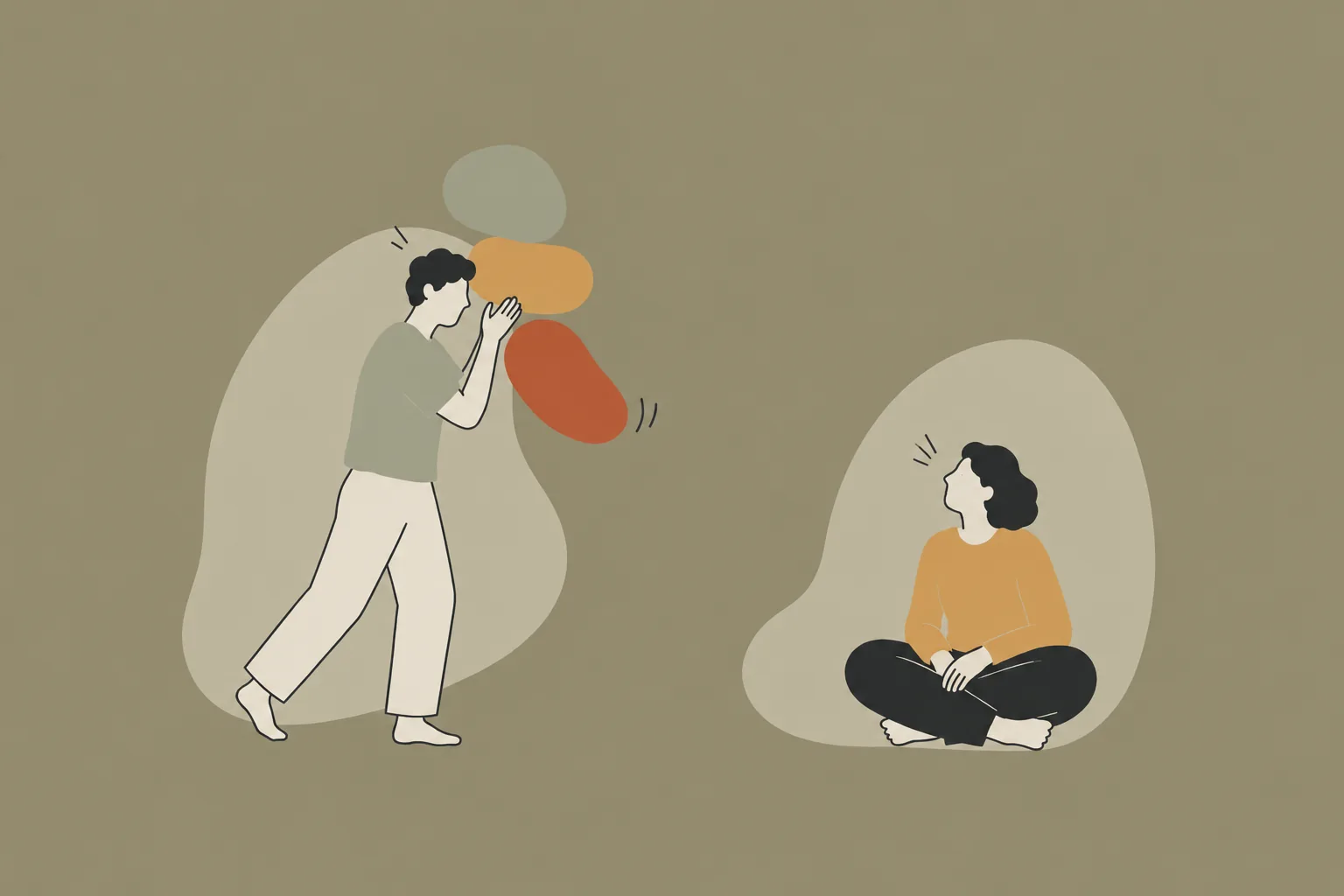
All day, they stayed calm in meetings, absorbed two clients’ anger, and finished overdue work. At home, their partner simply asked, “Did you forget to take out the trash?” The sharp response was far larger than the question. Minutes later came guilt: “I’m patient with everyone all day. Why can’t I tolerate the person I love most?”
This is not direct proof of a lack of love. Often, it reflects the day’s effort of regulation, suppressed anger, and unmet needs being carried into a close relationship.
Why does a partner’s small question sometimes trigger the weight of an entire day?
How does the working day come home?
Social life requires continual adjustment: controlling tone, avoiding misunderstandings, postponing anger, and reading others’ needs. This invisible effort accumulates. In the safety of a close relationship, control may drop more readily.
Repetti’s daily study of air traffic controllers and their spouses examined associations between workload and evening withdrawal or anger at home. The effects of high workload varied with spousal support. Later diary studies also found links between work stressors and same-day marital behavior.
These studies do not establish a simple law that work stress causes mistreatment of spouses. Effects vary by person, support, and context. They do suggest that a partner’s small action may be only the final straw; the rest of the load accumulated earlier.
Why does control drop in closeness?
We often lower our guard where we feel safest. A home in which feelings can be released is valuable. But if “They won’t leave me anyway” turns a partner into the target of every burden, safety erodes.
Understanding the mechanism does not excuse the behavior. “I’m exhausted” can explain something; it does not justify insults or contempt. Responsibility means recognizing the source of the burden and addressing it to the right person in the right language.
Work is not the only drain on capacity. Lack of sleep, hunger, caregiving, chronic pain, financial anxiety, and unequal relationship responsibilities can also reduce patience. Rather than treating “Why am I like this?” solely as a question of character, “What am I carrying right now?” offers a concrete starting point.
Thor’s endless drinking horn
In Norse mythology, Thor tries to empty a drinking horn in Útgarða-Loki’s hall. Confident in his strength, he takes several great draughts, yet the level hardly falls. Later, he learns that the horn was invisibly connected to the sea. The vessel looked small but reached into the entire ocean.
“Did you take out the trash?” can sometimes connect to a similarly invisible ocean: anger swallowed at work, tension in traffic, a to-do list, and an inability to rest. The partner cannot understand why such a small vessel produces such a large wave.
The myth suggests that sometimes the difficulty is not simply insufficient strength, but misjudging what we are facing. The solution is to notice what the horn is connected to, rather than take an even stronger draught.
A ritual for coming home
Moving directly from work or a demanding day into close relationship can be hard. A five- or ten-minute transition may help: a short walk, a shower, quiet, sitting without a phone, or saying, “I’m carrying a lot today. I want to settle a little before I become sharp with you.”
Adding a return time may prevent the need from sounding like rejection: “Let’s sit together in fifteen minutes.” The break becomes a promise to return more regulated rather than an escape.
If harshness has already occurred, repair needs to be clear:
“I spoke harshly to you. I don’t think you deserved it. I brought the weight of my day to you. I’d like to calm down and talk about this again.”
This is responsibility, not an excuse.
Does anger point to an unfair load?
If household care, planning, and emotional monitoring accumulate invisibly on one person, “Let’s speak more calmly” is insufficient. The couple needs to examine who seems more entitled to rest, make mistakes, and ask for support.
Brief notes over a week may help: At which times, with which requests and repeated situations, does difficulty peak? What happened beforehand? Mapping anger can reveal a concrete arrangement the couple can discuss.
Being more patient with loved ones does not always mean gritting our teeth harder. Sometimes it means noticing the load sooner, allowing transition time, and sharing responsibility at home more fairly.
References
- Repetti, R. L. (1989). Effects of daily workload on subsequent behavior during marital interaction: The roles of social withdrawal and spouse support. Journal of Personality and Social Psychology, 57(4), 651–659. https://doi.org/10.1037/0022-3514.57.4.651
- Story, L. B., & Repetti, R. (2006). Daily occupational stressors and marital behavior. Journal of Family Psychology, 20(4), 690–700. https://doi.org/10.1037/0893-3200.20.4.690
- Gross, J. J. (2015). Emotion regulation: Current status and future prospects. Psychological Inquiry, 26(1), 1–26. https://doi.org/10.1080/1047840X.2014.940781
- Snorri Sturluson. Prose Edda, Gylfaginning, 46–47. (Thor’s drinking-horn challenge.)