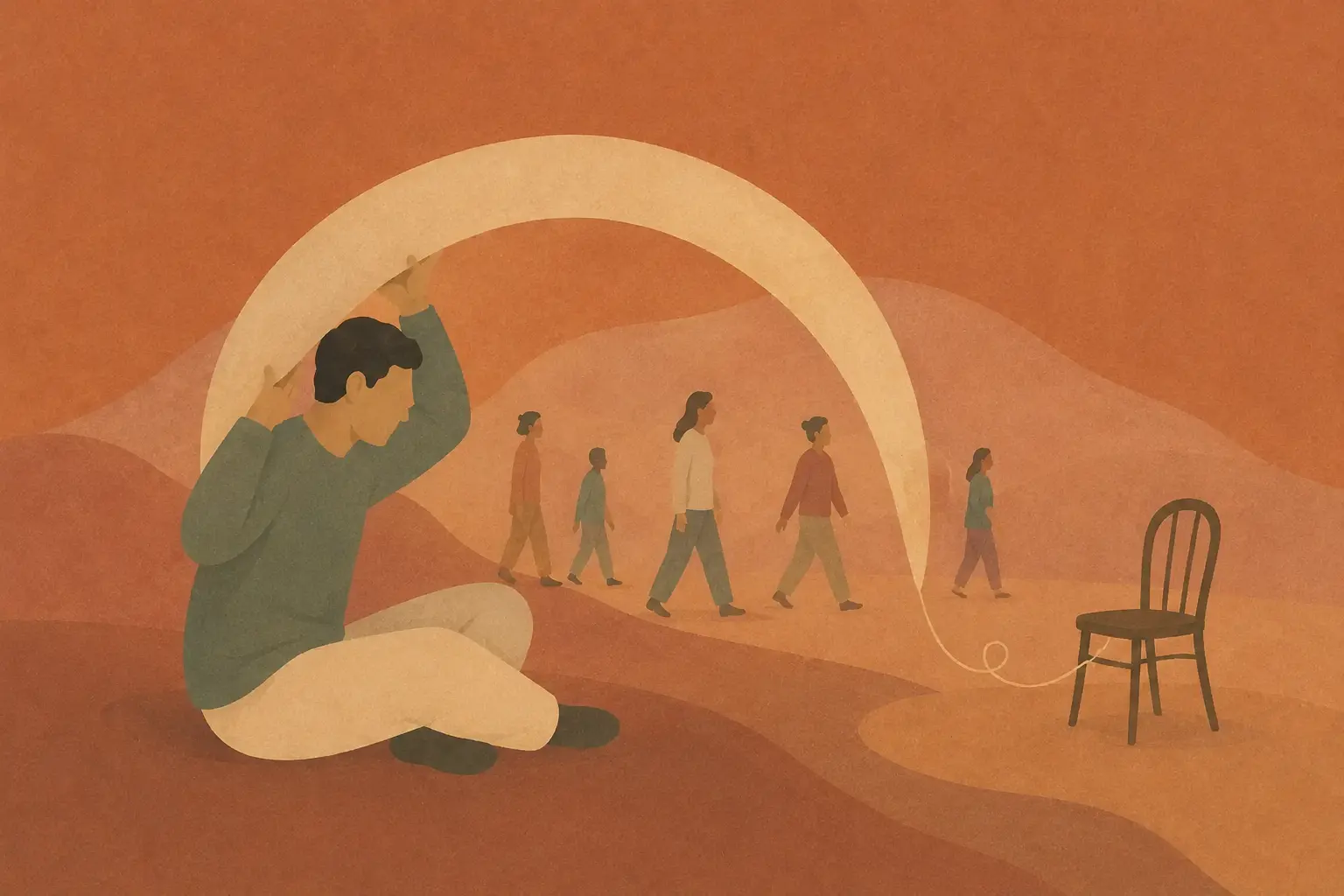
In their circle of friends, they are everyone’s first call. When a crisis happens, they stay calm, find solutions, and never leave anyone stranded. But one evening, they pick up the phone and stop, wondering whom to call. Asking for help feels unnatural, almost dangerous. Eventually, they close the screen and say the familiar words: “I’m fine. I’ll manage.”
Why can being strong sometimes mean giving up on being supported?
Strength and self-sufficiency are different
Psychological resilience does not mean never struggling or carrying every burden alone. Recognizing difficulty, adapting to circumstances, and seeking support when needed also demonstrate resilience. By contrast, the need to appear strong continually can become a protective strategy that conceals vulnerability. Collins and Feeney’s (2000) attachment-based study likewise treats support-seeking as a function of a secure relationship rather than a weakness.
Someone who was belittled when asking for help, whose needs went unmet, or who took on responsibilities early may conclude, “I must not depend on anyone.” This belief may once have protected them. Over time, however, it can become a habit that places an invisible wall before intimacy. Others assume they need no support, while they feel unseen.
The sky on Atlas’s shoulders
In Hesiod’s Theogony, Atlas is condemned to hold up the sky. His image is now often used to symbolize immense responsibility. Yet a detail is easily missed: carrying becomes the whole of his existence. It becomes difficult to know him apart from his burden.
The person who is always strong can become similarly confined. Their worth becomes equated with endurance. “I’m the one who holds things together” can gradually become “I’m valuable only while I hold things together.” Myth does not prove a psychological truth here, but it makes an experience visible: the burden can conceal the identity of the person carrying it.
An unexpressed need does not disappear
Not expressing an emotion does not make it vanish. Butler and colleagues’ (2003) interaction experiments and Gross and John’s (2003) research on individual differences suggest that habitual suppression of emotional expression may be associated with less closeness and lower social support. A person may look controlled while continuing to carry physiological and emotional strain.
This is not about telling everyone every feeling. Healthy boundaries and selective openness can coexist. Saying “I’m not doing well today” to someone trustworthy does not mean losing control; it means not denying your experience. Asking for support need not transfer the entire burden either. Sometimes it simply asks someone to bear witness.
How does loneliness develop?
Intimacy needs reciprocity. If one person always gives and the other always receives, the relationship can continue without contact deepening. The strong person may be loved, admired, and sought out, yet not feel truly known because their inner world remains unshared.
Fear of stigma also matters in help-seeking. Someone who expects to be seen as inadequate may hide their need. They avoid shame in the short term but reduce their chance of support over time. “No one is there for me” can then grow stronger because no one has had an opportunity to come closer. Vogel and colleagues’ (2007) research suggests that perceived public stigma can become self-stigma, reducing willingness to seek help.
Aristotle’s friendship and reciprocity
Aristotle treats friendship as a central part of a good life, rather than merely an exchange of benefits. In close bonds, people both give and receive; they are seen for who they are as well as what they do. This perspective does not reject strength. It places strength within relationships rather than solely in solitary endurance.
We can ask: What fear does asking for help awaken in me? How do I contribute to being known only as someone who solves problems? What might happen if I told someone I trust about a small need?
Strength is not never falling. Sometimes it means allowing a hand to reach you without hiding that you have fallen. Sharing a burden does not diminish a person; it opens a space in which others can approach them too.
References
- Aristotle. (1999). Nicomachean ethics (T. Irwin, Trans.; 2nd ed.). Hackett.
- Butler, E. A., Egloff, B., Wilhelm, F. H., Smith, N. C., Erickson, E. A., & Gross, J. J. (2003). The social consequences of expressive suppression. Emotion, 3(1), 48–67. https://doi.org/10.1037/1528-3542.3.1.48
- Collins, N. L., & Feeney, B. C. (2000). A safe haven: An attachment theory perspective on support seeking and caregiving in intimate relationships. Journal of Personality and Social Psychology, 78(6), 1053–1073. https://doi.org/10.1037/0022-3514.78.6.1053
- Gross, J. J., & John, O. P. (2003). Individual differences in two emotion regulation processes. Journal of Personality and Social Psychology, 85(2), 348–362. https://doi.org/10.1037/0022-3514.85.2.348
- Hesiod. (1988). Theogony and Works and Days (M. L. West, Trans.). Oxford University Press.
- Vogel, D. L., Wade, N. G., & Hackler, A. H. (2007). Perceived public stigma and the willingness to seek counseling. Journal of Counseling Psychology, 54(1), 40–50. https://doi.org/10.1037/0022-0167.54.1.40