Near midnight, the phone rang again. A close friend was crying. They listened at length, helped them settle, and promised to call the next day. After hanging up, they remembered how difficult their own day had been. They opened their messages, typed “I’m not doing well either,” then deleted it and put down the phone.
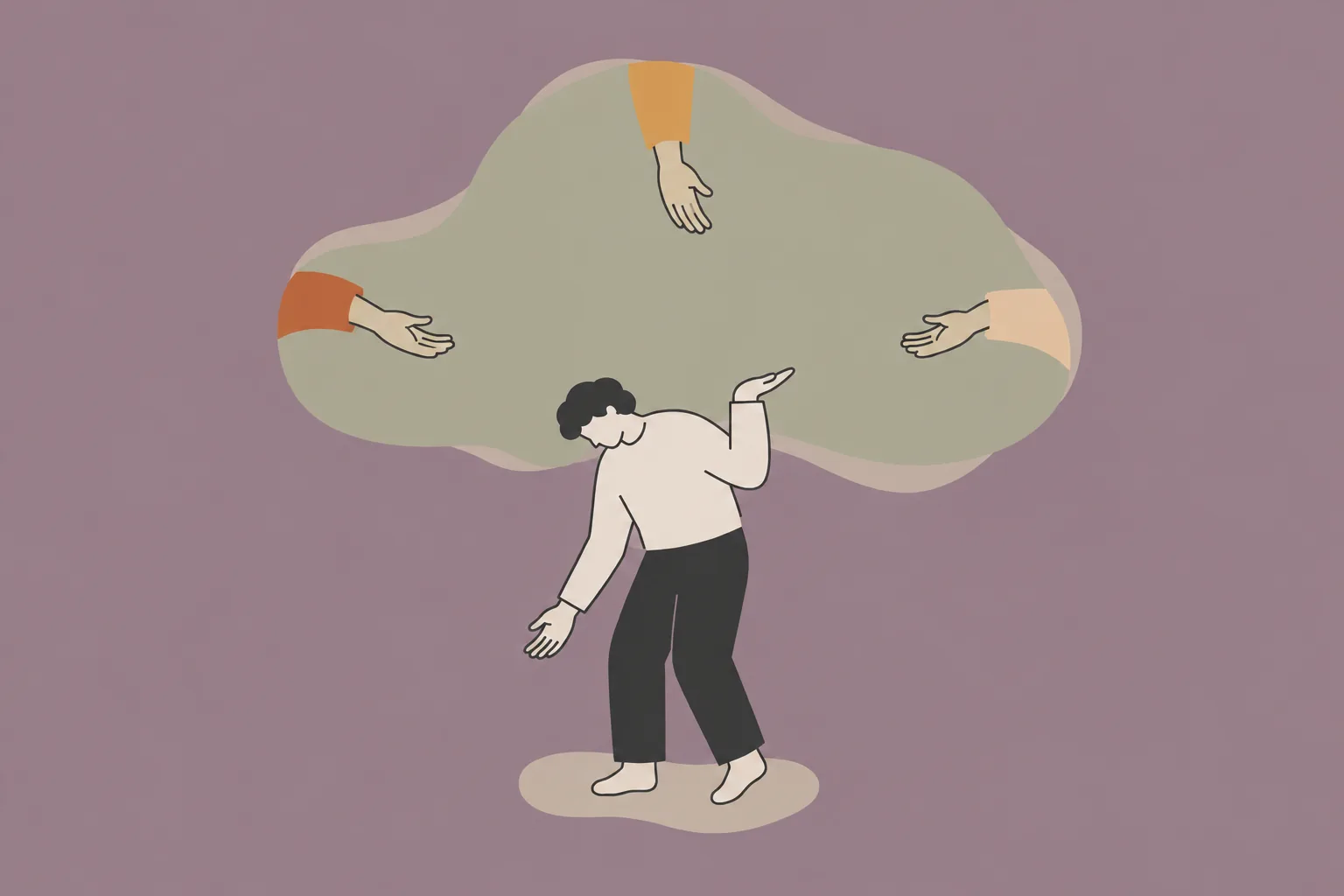
Some people are everyone’s call in difficult times. They remain calm in a crisis, solve problems, listen, and carry the load. Yet when their own lives become hard, making a call is far less easy.
This is not always shyness. For some, asking for help is a moment of intimacy in which vulnerability becomes visible, rather than a simple statement of need. Why does receiving support feel dangerous when offering it feels so natural?
A role learned in childhood: solve problems, don’t cause them
Some children learn very early to read the atmosphere at home. They notice an upset parent, calm a sibling, or postpone a need to avoid making things harder. Sometimes this is explicitly requested. Sometimes children sense that love and peace depend on being “easy,” “mature,” or “no trouble.”
Taking on adult responsibilities beyond one’s developmental stage can be described in psychology as parentification. Not every responsible child is parentified, and not every difficulty asking for help can be reduced to childhood. The concept helps explain only some people’s tendency to make room for others’ emotions before their own.
These experiences can also develop real skills, including empathy, resilience, and clear thinking in crises. The cost appears when someone learns that being useful is the condition of worth: “I can be loved, but I must not burden anyone.”
How does being the strong one become an identity?
Adult life rewards people who do not ask for help. They become reliable at work, everyone’s first call in the family, and the person praised for holding a relationship together. Being needed can make them feel valuable.
But when someone becomes known only for what they do, they may forget their need for support simply as a person. Others begin assuming they need no help. A dilemma develops: “I’m hurt that no one sees me, but I don’t show the need that would let them see me.”
This is a protective strategy rather than mere inconsistency. People want to be seen, yet can feel exposed when being seen requires showing a need.
Why does an invitation to closeness tense the body?
Someone may intellectually know a friend will not judge them, yet “Could you listen to me for a while?” can bring a racing heart or intense shame. Asking for help is an attachment signal as well as a reasoned decision.
If closeness was associated with belittling, unanswered needs, or being overwhelmed by another person’s burdens, someone may shut down feelings or tighten control. This is not a character defect. It is the continuation of a strategy that once worked.
Research on social support, health, and coping with stress shows that support matters not only in its existence, but in being reliable, accessible, and suited to the person’s needs. Learning to ask for help therefore does not mean opening up to everyone. It means discovering, through small experiences, who can offer which kind of support.
Atlas’s burden
In Greek mythology, Atlas is condemned to carry the vault of heaven on his shoulders. The image is powerful not only because the burden is enormous, but also because sharing it seems unthinkable.
In one account, Heracles briefly takes the burden. After experiencing its release, Atlas does not want it back. The scene challenges the idea that asking for help is weakness: someone who has carried a load for a long time may recognize how necessary rest is only after setting it down.
Mythology is not a scientific explanation. Atlas simply makes visible an inner sentence: “If I put my burden down, everything will fall apart.” Yet everything seeming to depend on you does not mean others cannot take responsibility. Sometimes they have simply not been given space.
Asking for help is different from being a burden
Sharing a need does not mean controlling someone, making unlimited demands, or disregarding their capacity. A thoughtful request respects both one’s own needs and the other person’s limits:
- “I’m having a hard day. Do you have ten minutes to listen?”
- “I could use your thoughts on something. Could we talk tonight?”
- “I’m not looking for a solution. Having you beside me would help.”
The ability to ask usually develops through small, trustworthy experiences rather than in a major crisis. Does the person listen? If they lack capacity, can they say so respectfully? Do they maintain the connection afterward? These responses teach us whom we can trust, and how much.
Learning to ask for help does not mean giving up strength. It means defining strength through the ability to connect as well as endure. The person who carries everyone’s burdens can sometimes sit down, speak, and receive support too. That makes them more human, not less reliable.
References
- Hooper, L. M. (2007). Expanding the discussion regarding parentification and its varied outcomes: Implications for mental health research and practice. Journal of Mental Health Counseling, 29(4), 322–337. https://doi.org/10.17744/mehc.29.4.4t41711075205454
- Mikulincer, M., Shaver, P. R., & Pereg, D. (2003). Attachment theory and affect regulation: The dynamics, development, and cognitive consequences of attachment-related strategies. Motivation and Emotion, 27, 77–102. https://doi.org/10.1023/A:1024515519160
- Repetti, R. L., Taylor, S. E., & Seeman, T. E. (2002). Risky families: Family social environments and the mental and physical health of offspring. Psychological Bulletin, 128(2), 330–366. https://doi.org/10.1037/0033-2909.128.2.330
- Taylor, S. E. (2011). Social support: A review. In H. S. Friedman (Ed.), The Oxford Handbook of Health Psychology (pp. 189–214). Oxford University Press. https://doi.org/10.1093/oxfordhb/9780195342819.013.0009
- Apollodorus. Library, 2.5.11. (Heracles and Atlas.)