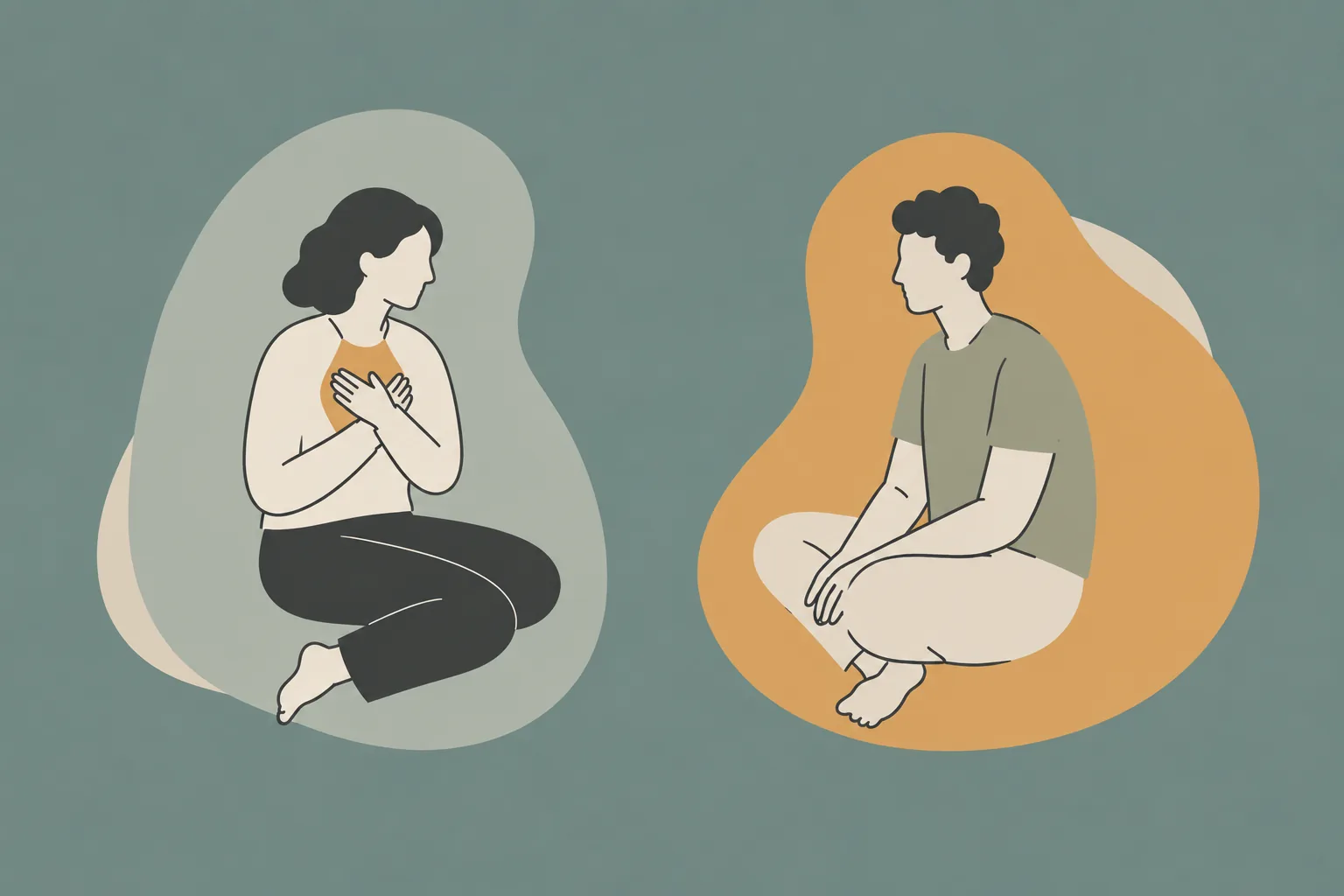
They wanted no grand birthday celebration, just a quiet evening together. They did not say so. When their partner arranged a gathering with friends, they smiled all night and withdrew on returning home. “If they knew me, they would know what I wanted,” they thought. Their partner had no idea they were being tested.
A familiar expectation in intimacy is “If they love me, they should understand without my saying anything.” Once a need is expressed, its fulfillment seems less spontaneous, as if the other person will do it only because they were asked. Left unspoken, however, it creates the hurt of being unseen.
This dilemma may concern trust that a need will be heard more than a lack of love. Why is it hard to tell the person closest to us what we want?
Why can expressing a need feel risky?
If childhood feelings had no room, wishes were belittled, or requests met with “Don’t exaggerate,” an adult may associate asking with being a burden. Others encountered anger, mockery, or withdrawal after expressing a need. Silence can then look like a strategy that protects the relationship.
Adult experiences matter too. Rejection in previous relationships, a current partner’s defensiveness, the belief “I must be strong,” and gender roles can all complicate openness. The difficulty is not always a person’s communication skill: some relationships genuinely make expressing needs unsafe.
An unspoken need does not disappear. It often returns as reproach, withdrawal, hints, or unexpected anger. The partner sees this secondary reaction instead of the underlying need.
Intimacy is not mind-reading
Closeness allows partners to know each other better, but does not confer complete access to each other’s thoughts. When both enter an undefined test, the relationship can quickly feel like failure: one is hurt that “They didn’t understand me,” while the other tires of “Nothing I do is enough.”
In intimacy research, perceived partner responsiveness means feeling understood, cared for, and accepted by another person. Laurenceau and colleagues’ study of everyday interactions found that self-disclosure and perceived responsiveness were associated with intimacy. The connection arose through one person opening up and the other responding, rather than through perfect mind-reading.
This does not place all responsibility on the person expressing a need. Openness requires reciprocity: one must be able to speak, and the other to listen without belittling or immediately becoming defensive.
Ariadne’s thread
When Theseus enters the labyrinth, Ariadne gives him a thread. It does not remove the monster or walk the path for him; it makes the way back visible.
Clear statements of need work similarly. They offer information about the path rather than a labyrinth for a partner to solve. Instead of “You should understand me,” saying “When I’m struggling, sitting beside me helps more than immediately suggesting solutions” indicates a direction for closeness.
This does not diminish romance. Meeting a need knowingly does not devalue it. It enables a partner to respond to the real you rather than to a guessing game.
A request is not a command
Separating the experience from the concrete request may reduce defensiveness:
- “I’ve been feeling distant lately. Could we walk together for twenty minutes tonight?”
- “This feels hard to work through alone. Could you listen without giving advice right now?”
- “I need to feel understood before being criticized. Could you first hear how I experienced it?”
A request is not an order that requires agreement. Your partner has the right to say no; you have the right to expect your request to be heard without ridicule or punishment. Trust grows not through needs never being declined, but through the bond remaining intact even when they are.
After years of silence, suddenly describing one’s deepest hurt can be difficult. Smaller, time-limited requests can be a starting point. A partner’s responses also provide information about the relationship’s capacity.
If needs are persistently belittled, mocked, punished with anger, or ignored, the question goes beyond “How can I express myself better?” A more basic one is “Is there a safe space in this relationship for me to express myself?”
Being loved does not mean being understood without speaking. A more realistic intimacy involves two people willing to keep learning each other.
References
- Laurenceau, J.-P., Barrett, L. F., & Pietromonaco, P. R. (1998). Intimacy as an interpersonal process: The importance of self-disclosure, partner disclosure, and perceived partner responsiveness in interpersonal exchanges. Journal of Personality and Social Psychology, 74(5), 1238–1251. https://doi.org/10.1037/0022-3514.74.5.1238
- Debrot, A., Cook, W. L., Perrez, M., & Horn, A. B. (2012). Deeds matter: Daily enacted responsiveness and intimacy in couples’ daily lives. Journal of Family Psychology, 26(4), 617–627. https://doi.org/10.1037/a0028666
- Downey, G., Freitas, A. L., Michaelis, B., & Khouri, H. (1998). The self-fulfilling prophecy in close relationships. Journal of Personality and Social Psychology, 75(2), 545–560. https://doi.org/10.1037/0022-3514.75.2.545
- Plutarch. Theseus, 19. (Ariadne’nin ipi.)