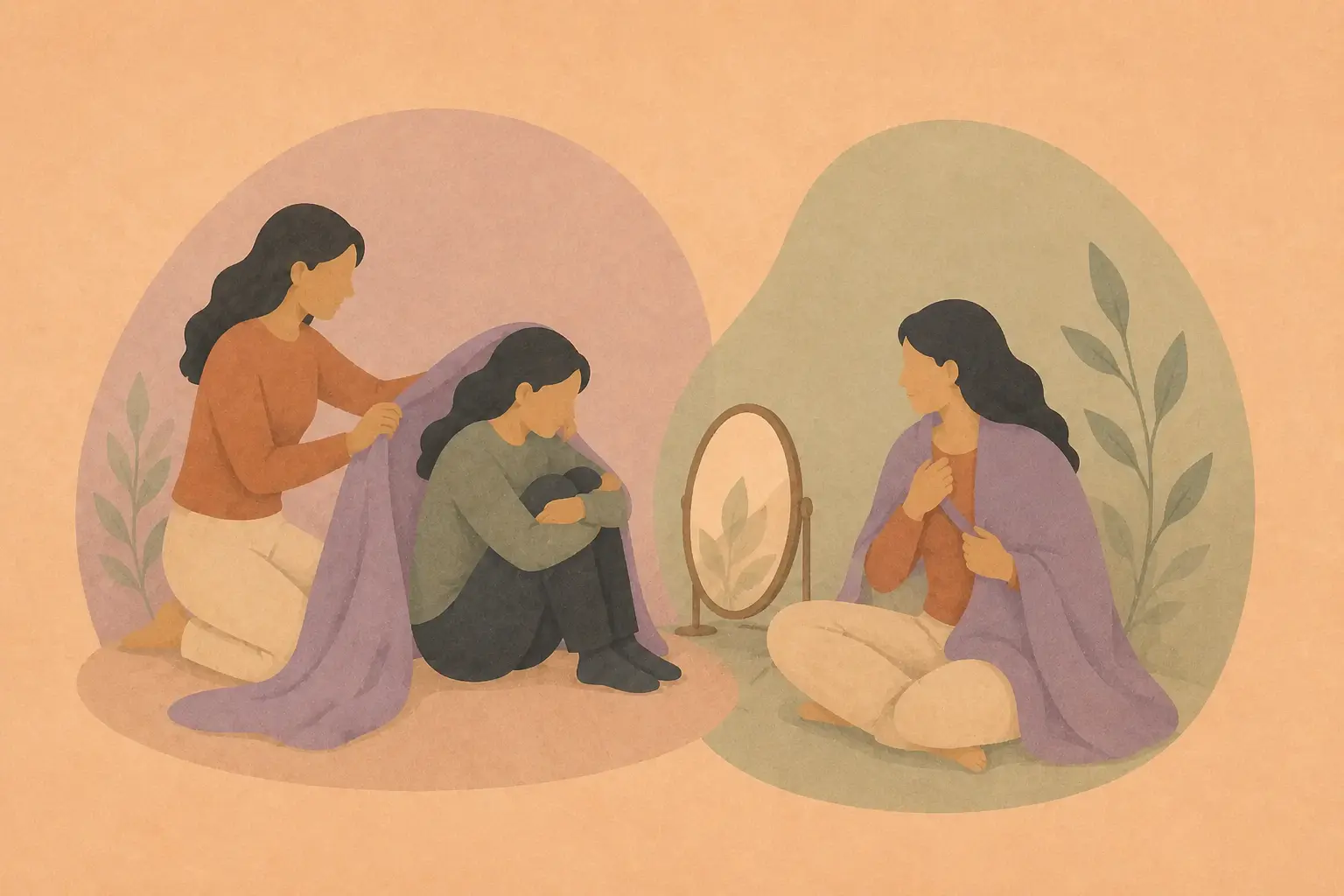
When a close friend makes a mistake, someone responds patiently: “You’re going through a difficult time. This one event doesn’t define you.” Making the same mistake themselves, they hear a harsh inner voice: “You failed again.” Compassion is there, but it faces only outward.
Why do we believe harshness toward ourselves is necessary for growth?
The control promised by the inner critic
The critical voice often claims it will motivate us, prevent mistakes, or keep arrogance in check. We fear failure if we ease up, so harshness becomes associated with discipline.
But demeaning self-talk threatens the self more than it informs behavior. A threatened mind may turn toward defense, avoidance, or hopelessness. Self-compassion preserves responsibility while approaching mistakes with humanity, awareness, and kindness. MacBeth and Gumley’s (2012) meta-analysis reports a strong, consistent inverse association between self-compassion and depression, anxiety, and stress.
Chiron: the wounded healer
Chiron, described in Apollodorus’s Library, is the wise centaur who teaches healing but cannot heal his own wound. The “wounded healer” evokes someone skilled at recognizing others’ pain yet unable to reach their own. Helping another person can sometimes be easier than touching our vulnerability.
The myth shows a limit rather than merely glorifying sacrifice: possessing knowledge and compassion does not mean we can automatically apply them to ourselves.
What self-compassion is not
As defined by Kristin Neff (2003), self-compassion is not self-pity, avoidance of responsibility, or approval of every behavior. It has three central aspects: noticing difficulty without denying it, remembering that suffering belongs to human experience, and not treating ourselves as an enemy.
“What are the consequences of this mistake, and how can I repair them?” is compatible with self-compassion. “I am worthless” provides no route to repair. We can critique behavior without punishing the entire person.
Changing the inner voice’s tone
In a difficult moment, try a brief exercise. First describe the event without interpretation. Then consider what you would say to someone you love in that situation. Finally, direct a believable part of that sentence toward yourself. If “You’re wonderful” feels false, “I’m struggling right now, and I can choose the next small step” may be enough.
Self-compassion does not abandon development; it provides safer conditions for it. When we stop withholding the humanity we offer others, a mistake remains a mistake and responsibility remains responsibility. What changes is who stands beside us: a more honest ally in place of the inner judge.
The language of compassionate responsibility
Self-criticism is often broad and insulting: “You’ve ruined everything again.” Compassionate responsibility is concrete: “I delayed that message and left them uncertain. Today I can apologize and give them a new time.” The second does not minimize the mistake; it makes repair visible.
Self-compassion may initially feel false or weak because the harsh voice has held authority for years. It can help to begin with fairness rather than warmth: “If someone else were in this situation, I would not consider them entirely worthless.” Fairness can provide a more believable bridge to compassion.
Self-compassion also includes boundaries. Being kind to ourselves may mean protecting sleep, asking for help, leaving a harmful relationship, or facing a behavior’s consequences rather than doing something pleasant. Compassion is consolation and a courageous stance that protects life.
A standard of fairness for the inner voice
- What fair sentence would I offer someone I love in this situation?
- Does my harsh inner voice actually move me to act, or does it freeze me?
- What sentence would preserve both responsibility and dignity?
Compassionate language may feel unfamiliar; its effects become clearer through repetition. The criterion is not sweetness, but contact with reality and room for repair.
A simple test of the inner voice is whether we would say the same sentence to a child or close friend. If not, keep the useful information and remove the insult. “You missed this detail; you could use a checklist before sending” can replace “You’re careless.” This does not lower a standard in the name of gentleness. It translates the standard into usable behavior.
References
- MacBeth, A., & Gumley, A. (2012). Exploring compassion. Clinical Psychology Review, 32(6), 545–552. https://doi.org/10.1016/j.cpr.2012.06.003
- Neff, K. D. (2003). Self-compassion. Self and Identity, 2(2), 85–101. https://doi.org/10.1080/15298860309032
- Apollodorus. (1997). The library of Greek mythology (R. Hard, Trans.). Oxford University Press.