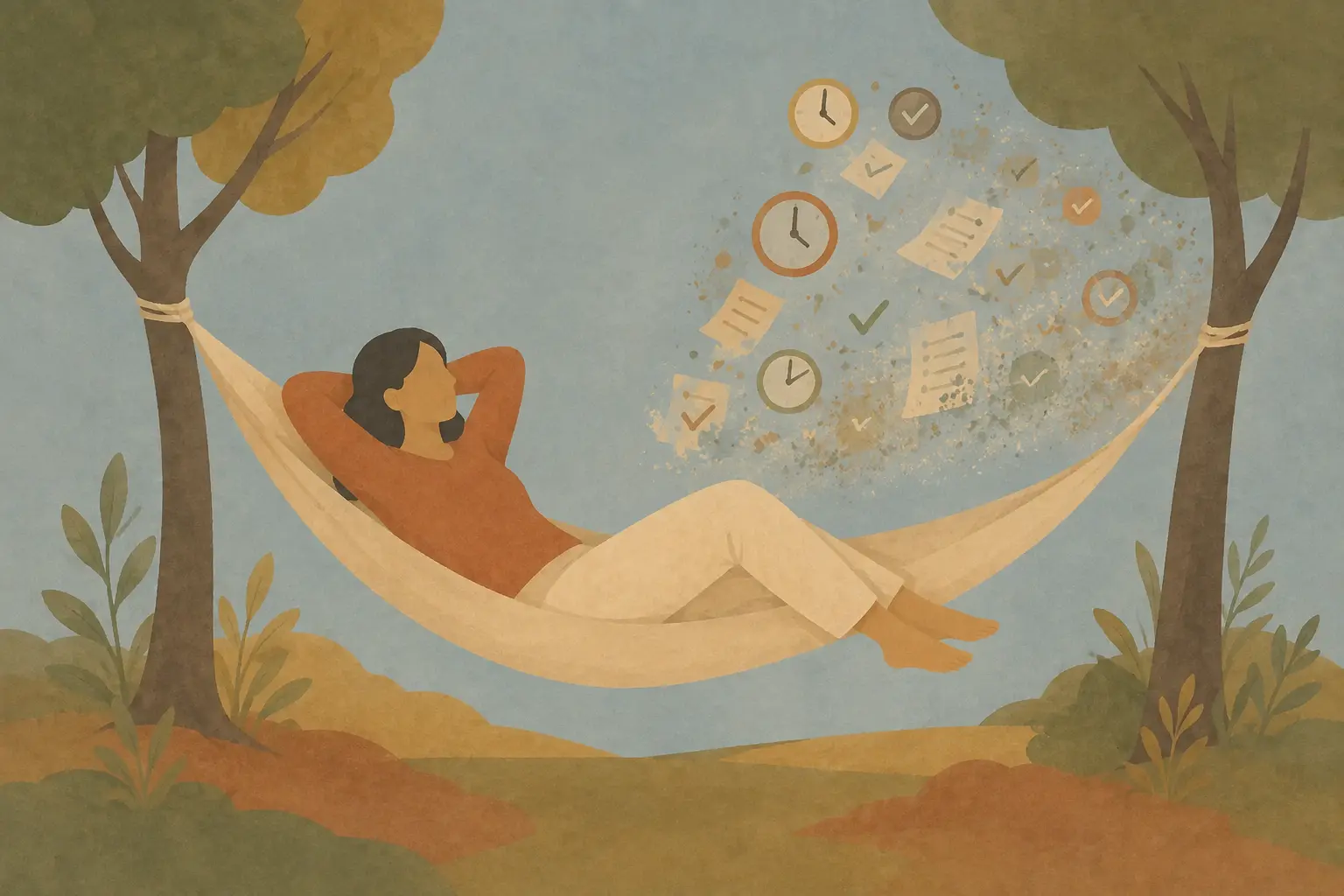
It is Sunday afternoon. Someone sits on the sofa but cannot rest. Possible tasks run through their mind; social media shows others being productive. Their body is still while an inner counter keeps running: “You’re wasting time.”
Why does rest sometimes feel like a reward that must be earned?
When worth and productivity merge
Achievement, responsibility, and effort are important values. But when worth rests solely on work, inactivity threatens identity. “I produced nothing today” quickly becomes “I am worthless today.”
As Crocker and colleagues’ (2003) research on contingent self-worth suggests, tying worth to achievement in certain domains turns those domains into continuous tests. Finishing a task brings brief relief, followed by the need for more proof. Rest is accepted only insofar as it serves the next performance.
Vita activa and vita contemplativa
Philosophy has long debated the active life and the contemplative life. Aristotle argues that a good life is not solely production; contemplation has value of its own. In modern culture, time without visible output is easily dismissed as empty.
Yet rest is more than maintenance that allows further work. Play, reflection, and aimless wandering are independently valuable parts of human experience. Not every moment needs to produce an outcome.
The cost of seeing leisure as waste
Tonietto and colleagues’ (2021) research suggests that people who consider leisure unproductive or wasteful may enjoy it less. Guilt spoils rest and may leave someone unable either to rest fully or to work, suspended in tense waiting.
Scheduling rest can initially help, but it need not become another project to optimize. “I must do nothing between three and four” creates a new performance demand. A gentler permission is: “This time does not have to produce anything.”
Guilt is not always a compass
Guilt does not always mean wrongdoing. Sometimes it appears when an internalized rule is broken. We can examine where “Rest is laziness” came from, whom it serves, and whether it still fits our present life.
Doing nothing is not literally nothing. The body recovers, attention wanders, and experiences settle. Human value cannot be measured as if we were machines producing continuous output. Rest belongs to the rhythm that sustains life rather than placing us outside it.
Looking at what follows rest
Instead of debating whether rest is deserved, we can observe its effects. How do the body, attention, and patience change after a short break? Some forms replenish us, while others leave dullness or greater fragmentation. This is a functional rather than moral distinction, helping people find a suitable rhythm.
Aimless scrolling can sometimes be rest and sometimes avoidance. Feeling more gathered or more scattered afterward offers a clue. Walking, sleeping, talking, playing, and quiet meet different needs. “What do I need?” matters alongside “I should rest.”
It is unfair to treat rest solely as a personal choice while ignoring social and economic conditions. Care responsibilities, insecure work, and long hours create real limits. Still, it may be possible to value small intervals and request support or shared responsibilities. Rest is a shared condition of sustainable life, not simply an individual luxury.
Giving permission to rest
- Which endless conditions do I believe must be met before I can rest?
- Which forms of rest leave me feeling more whole?
- Can I allow ten minutes today that produce no outcome?
When rest-related guilt appears, we can acknowledge it and continue the break. A feeling’s arrival does not require obedience. As a new rhythm develops, an old rule may briefly raise its voice.
References
- Aristotle. (1999). Nicomachean ethics (T. Irwin, Trans.; 2nd ed.). Hackett.
- Crocker, J., Luhtanen, R. K., Cooper, M. L., & Bouvrette, A. (2003). Contingencies of self-worth in college students. Journal of Personality and Social Psychology, 85(5), 894–908. https://doi.org/10.1037/0022-3514.85.5.894
- Tonietto, G. N., Malkoc, S. A., Reczek, R. W., & Norton, M. I. (2021). Viewing leisure as wasteful undermines enjoyment. Journal of Experimental Social Psychology, 97, 104198. https://doi.org/10.1016/j.jesp.2021.104198