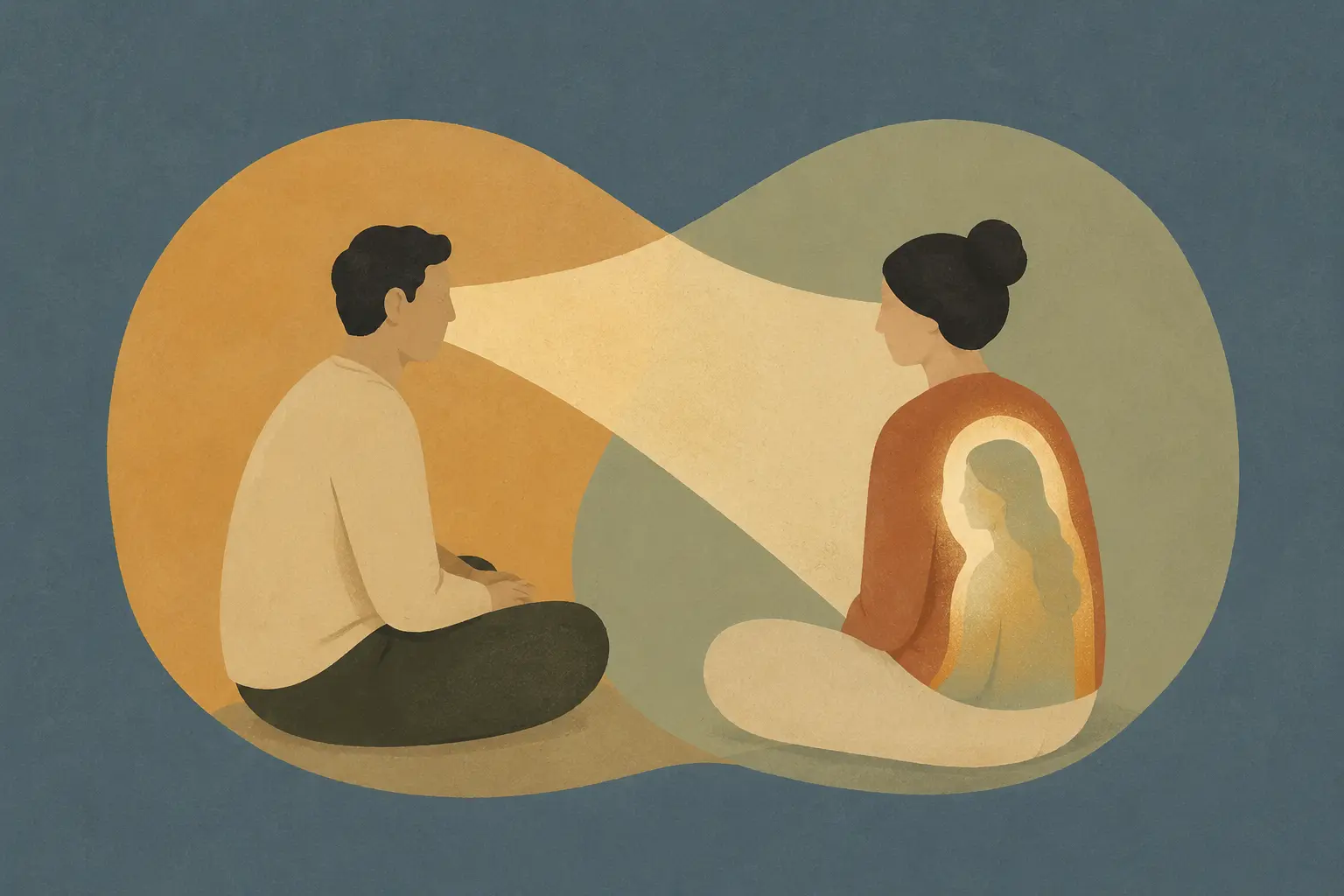
Over dinner, one partner starts talking about their day. Before the sentence is finished, the other is already predicting what comes next and preparing a response. They think they know what will have upset their partner, whom they will criticize, and how they will eventually fall silent. In the comfort of years together, something small goes unnoticed: their partner is speaking, but no longer being truly heard.
In long relationships, fading curiosity is often mistaken for the end of love. Yet we can keep loving someone while giving up the effort to know them. Closeness brings a feeling of “I know you.” That feeling offers security, but over time it can also turn a partner into a story we consider finished.
Why can familiarity make us see less?
Rather than examining a familiar world from scratch each time, the mind makes predictions. This helps everyday life run with less effort. Gradually, we also begin to classify our partner’s expressions, words, and reactions at speed. “They’re saying the same thing again,” “I already know this,” or “They’re definitely about to get angry” may sometimes prove right. But the more often our predictions are right, the less inclined we may become to notice new information.
Familiarity itself is not the problem. Some of the peace of living together depends on being able to anticipate each other’s behavior. The problem begins when prediction takes the place of observation. Once we stop allowing for the possibility that our partner can change, the person they are now gets filed away under who they used to be.
Boredom may not be the opposite of love
In a study of long marriages by Irene Tsapelas, Arthur Aron, and Terri Orbuch, boredom reported in the seventh year of marriage predicted lower satisfaction nine years later. Reduced closeness accounted for a substantial part of this association. It would be wrong to read the finding as “Everyone who gets bored separates.” What the study suggests is that boredom is not an insignificant detail.
Research by Arthur Aron and colleagues also found that taking part in new, stimulating activities together could be associated with short-term improvements in relationship quality. Novelty here is about more than trying a different restaurant. It creates an opportunity to see how a partner thinks in an unfamiliar situation, what makes them laugh, or where they struggle.
Sometimes curiosity fades not because life has become routine, but because we begin to see a partner mainly through what they do. Alongside being the person we love, they become the person who pays the bills, picks up the child, does the shopping, or causes problems. The roles remain visible while the person recedes.
Psyche’s lamp
In Greek mythology, Psyche cannot see the face of Eros, who visits her at night. One night, she takes a lamp and looks at his face in the darkness. The story has many interpretations, but this moment suggests that intimacy involves not only trust, but also a willingness to see.
In a long relationship, too, it is easier to hold on to a ready-made image of a partner. Looking closely may reveal that they no longer think as they once did, that they have a new desire, or that they no longer want to inhabit the role we have assigned them. Curiosity is more than a romantic exercise: it means accepting the other person’s right to change.
How can curiosity return without becoming an interrogation?
Couples do not need to ask each other a prepared set of questions every evening. Often, curiosity simply means suspending the assumption that we already know the answer. It can be as small as asking “What wore you out most today?” instead of “What did you do today?” Following up on a detail, rather than immediately solving, correcting, or responding with a story of our own, is another form of curiosity.
These questions may open up a conversation:
- Have you changed your mind about anything lately?
- Is there something in your life right now that you find difficult to tell me about?
- Is there a part of you that I might still be seeing as you used to be?
Their value lies not just in asking, but in making room for an unexpected answer. Without curiosity, even a question can become a way of seeking confirmation: we listen to prove what we already believe rather than to understand.
Love may keep a bond going; curiosity keeps that bond connected to a living, changing person. Knowing someone for years does not mean knowing everything about them. Perhaps the most mature thing we can say in a long relationship is not “I know you,” but “I’m ready to hear who you are today.”
References
- Aron, A., Norman, C. C., Aron, E. N., McKenna, C., & Heyman, R. E. (2000). Couples’ shared participation in novel and arousing activities and experienced relationship quality. Journal of Personality and Social Psychology, 78(2), 273–284. https://doi.org/10.1037/0022-3514.78.2.273
- Bühler, J. L., Weidmann, R., Wünsche, J., Burriss, R. P., & Grob, A. (2020). Daily responsiveness, expectations, and self-disclosure: How the average levels and within-person variability of three relationship components mediate personality–relationship transactions in romantic couples. European Journal of Personality, 34(3), 367–392. https://doi.org/10.1002/per.2255
- Tsapelas, I., Aron, A., & Orbuch, T. (2009). Marital boredom now predicts less satisfaction 9 years later. Psychological Science, 20(5), 543–545. https://doi.org/10.1111/j.1467-9280.2009.02332.x