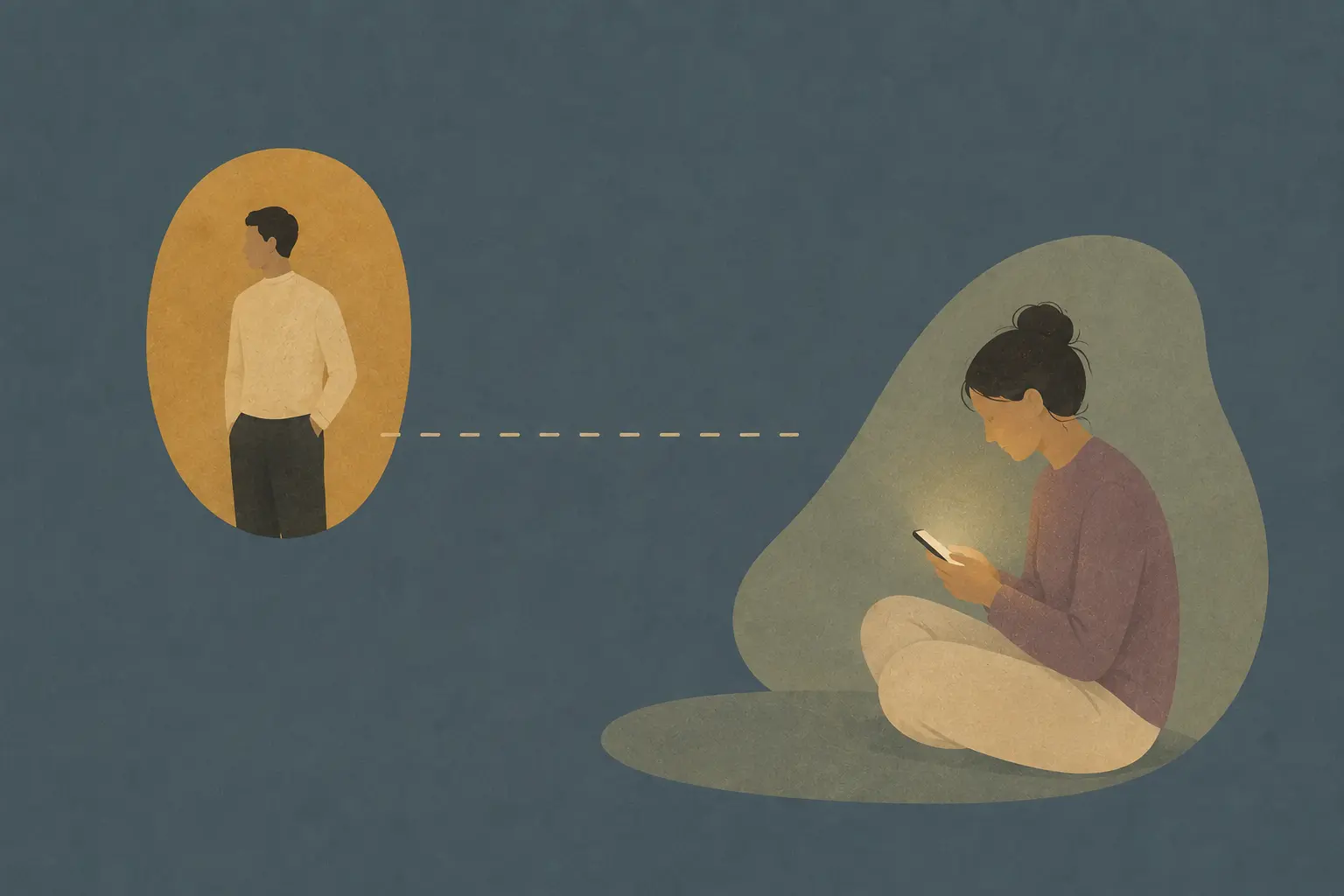
The message is marked “seen.” A few minutes later, they notice their partner is online in another app. At first, they think their partner may be busy. Then the mind begins filling in the gaps: “They’re angry with me,” “I don’t matter to them,” “They’re talking to someone else.” As the phone stays silent, this begins to feel less like a delayed reply and more like a test of the relationship’s worth.
Digital communication has made people accessible across a distance. It has also created a new expectation: someone who appears available should respond. Online status, last-seen timestamps, and read receipts provide a great deal of information, but do not explain what that information means. Technology that is supposed to reduce uncertainty sometimes simply makes it more visible.
Why does silence so quickly feel like rejection?
In face-to-face conversation, we have clues about why someone has gone quiet. We can see their tiredness, distraction, or an unsuitable setting. In messaging, that context is missing. We know “They saw it but didn’t reply”; we do not know why. The mind often fills this gap with past experiences and present fears.
Experimental studies of exclusion through text messaging have shown that being left without a response can quickly affect feelings of belonging, self-esteem, control, and meaning. This does not mean every delay is deliberate exclusion. It does, however, help explain why the body can respond so strongly to social silence.
Some people with higher attachment anxiety may be more sensitive to ambiguous relationship signals. Even so, a person’s attachment pattern cannot be inferred from their reaction to a single message. Lack of sleep, previous betrayals, a new relationship, or a partner’s past use of silence as punishment can also make waiting harder.
Constant access has created a new relationship rule
Hall and Baym’s research on mobile communication suggests that using the phone to maintain a relationship can increase both connection and the pressure to respond. As communication becomes easier, the question “Why didn’t they get back to me straight away?” becomes more readily available. Technology becomes not just a means of contact, but a gauge of how much someone cares.
Yet being online is not the same as being emotionally ready to talk. Someone may be able to answer a work message briefly, watch a video, or distract themselves, while needing more time to respond thoughtfully to an emotionally demanding message from a partner. This possibility does not prove that every delay is innocent. It simply shows that digital signals have no single, certain meaning.
A delay or a pattern?
Not receiving a reply one evening is different from repeated silence used to control a relationship. If a partner disappears for days after arguments, leaves the other person in uncertainty while visibly online, or says they are withholding replies as punishment, the issue goes beyond texting preferences.
On the other hand, two people may simply have different expectations about response times. One sees a message as part of an ongoing conversation; the other sees it as a note to answer when convenient. Left unspoken, this difference can blur the distinction between indifference and a different personal rhythm.
Looking beyond the phone screen
Repeatedly checking someone’s online status during intense anxiety may briefly offer a sense of certainty. But because it produces no new answer, it can deepen uncertainty. It may help to first separate the information available from the interpretation being made: the information is that the message was seen. “I don’t matter to them” is one possible interpretation.
At a calmer moment, couples can talk explicitly about their expectations for digital communication. Is a brief update possible on busy days? Which messages count as urgent? What can the person who cannot reply do? What has silence meant in the past?
The aim is not to make a partner constantly available. It is to establish shared expectations so that neither person has to struggle with uncertainty alone.
The little green dot tells us that someone is connected to their phone; it does not tell us everything about their emotional connection to us. The pain may be real without the mind’s first explanation being certain.
References
- Goodcase, E. T., Nalbone, D. P., Hecker, L. L., & Latty, C. (2018). The role of attachment anxiety and avoidance in communication modality and relationship quality of romantic relationships initiated online. The American Journal of Family Therapy, 46(2), 168–183. https://doi.org/10.1080/01926187.2018.1461032
- Hall, J. A., & Baym, N. K. (2012). Calling and texting (too much): Mobile maintenance expectations, (over)dependence, entrapment, and friendship satisfaction. New Media & Society, 14(2), 316–331. https://doi.org/10.1177/1461444811415047
- Smith, A., & Williams, K. D. (2004). R U there? Ostracism by cell phone text messages. Group Dynamics: Theory, Research, and Practice, 8(4), 291–301. https://doi.org/10.1037/1089-2699.8.4.291