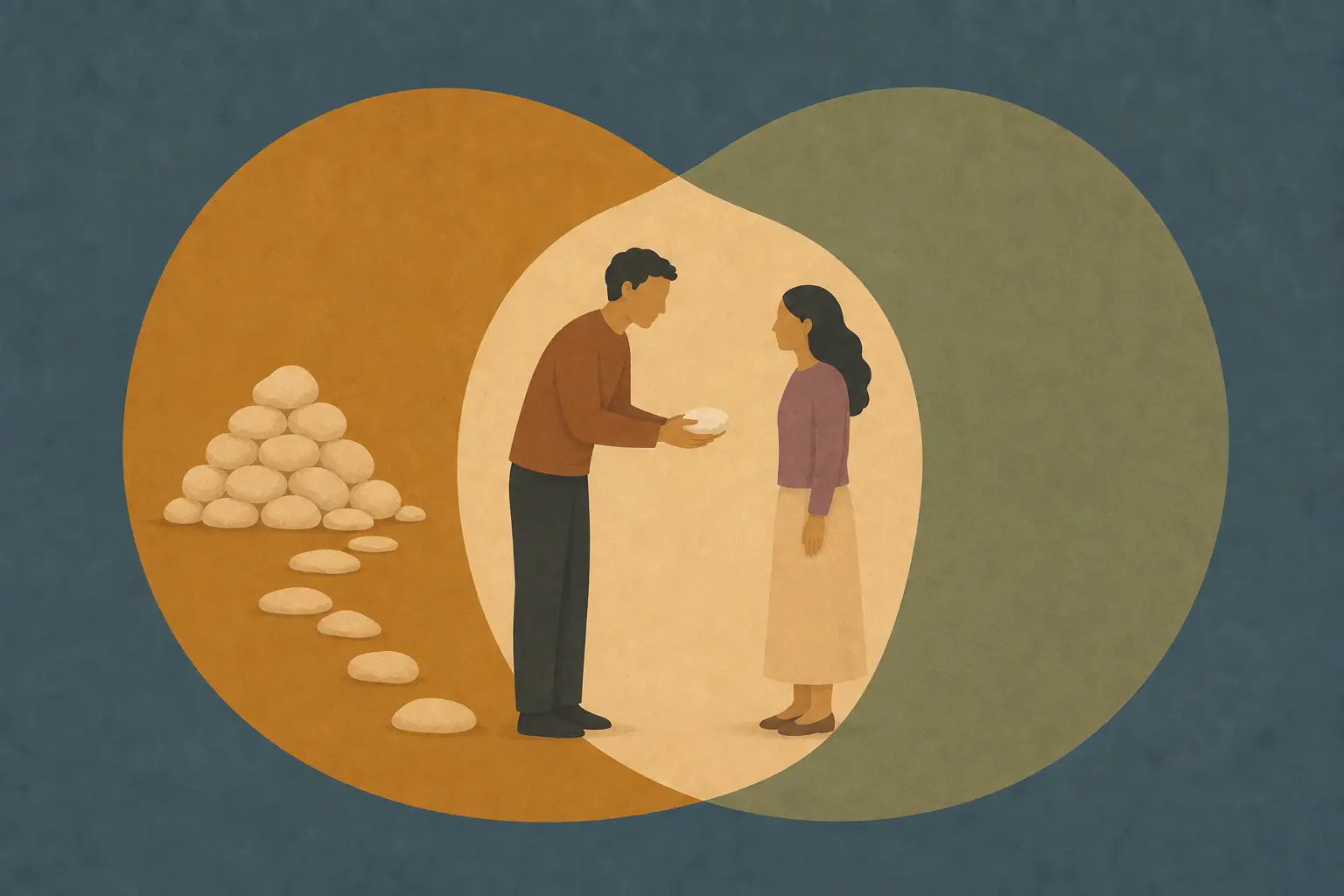
After the argument, the same person comes into the kitchen again. To close the subject, end the silence, and stop the evening dragging on, they say, “I’m sorry.” They are still hurt. Their partner relaxes, but when a similar argument recurs weeks later, another sentence grows inside the one who apologized: “Why am I always the one buying peace?”
The same person repeatedly apologizing does not mean they are more at fault every time. They may take the first step because conflict is harder to bear, they fear abandonment, they learned early to soothe the atmosphere, or they feel more responsible for keeping the relationship going.
An apology is not always an acceptance of responsibility
A genuine apology acknowledges harm, accepts one’s part, and, where possible, expresses an intention to repair. But “I’m sorry” can also end an argument, stop someone’s anger, escape punitive silence, or reduce the possibility of being left.
Then the apology regulates tension rather than repairs harm. It brings short-term calm while repeatedly assigning responsibility to one person. Over time, the apologizing partner suppresses their own hurt and the relationship’s imbalance grows.
What does each person count as wrongdoing?
Karina Schumann and Michael Ross’s research suggested that women’s greater frequency of apologies could not be explained merely by greater guilt. Women in the study also rated everyday behaviors as hurtful more often: the threshold for an apology differed. This does not mean all women are more sensitive or all men less so. It suggests that standards for harm and responsibility may differ through factors including gender roles and socialization.
Within a couple, one may see raised voices as a serious violation while the other considers them ordinary arguing. One sees a forgotten promise as requiring an apology; the other feels responsible only if there was intent. Without a shared language for harm, the person with the lower threshold keeps apologizing.
Pride, power, or defense?
For some people, apologizing feels like declaring themselves entirely bad or weak rather than acknowledging one mistaken behavior. Shame makes “I did this wrong” collapse into “I am wrong.” To avoid that conclusion, they may minimize the event, defend their intentions, or return the blame.
In the Iliad, the conflict between Agamemnon and Achilles grows around how power and honor can be repaired as well as the original injustice. Offered compensation fails to acknowledge the injured person’s humiliation adequately. The story speaks to relationships today: paying a price or saying “Fine, sorry” may not repair anything when the harm has not truly been seen.
The value of an apology depends on the relationship’s climate
In Schumann’s diary study of couples, the association between apologies and forgiveness was linked to perceived sincerity and existing relationship satisfaction. Repeated apologies without behavioral change gradually lose credibility. Conversely, where trust has deeply eroded, even a sincere apology may not be immediately accepted.
Repair needs a clearer structure than “I’m sorry, but you also…” What did I do? How might it have affected you? What is my part? What will I do differently next time? Not expecting immediate forgiveness is also part of responsibility.
The person who always apologizes can pause before automatically restoring peace: What behavior am I actually taking responsibility for? Am I simply trying to end the tension? Where is my own hurt in this conversation?
When one person always makes peace, there may be many apologies but little repair. A healthy apology shows that both people can recognize their impact on the relationship, rather than revealing who surrenders sooner.
References
- Forster, D. E., Billingsley, J., Burnette, J. L., Lieberman, D., Ohtsubo, Y., & McCullough, M. E. (2021). Experimental evidence that apologies promote forgiveness by communicating relationship value. Scientific Reports, 11, 13107. https://doi.org/10.1038/s41598-021-92373-y
- Schumann, K., & Ross, M. (2010). Why women apologize more than men: Gender differences in thresholds for perceiving offensive behavior. Psychological Science, 21(11), 1649–1655. https://doi.org/10.1177/0956797610384150
- Schumann, K. (2012). Does love mean never having to say you’re sorry? Associations between relationship satisfaction, perceived apology sincerity, and forgiveness. Journal of Social and Personal Relationships, 29(7), 997–1010. https://doi.org/10.1177/0265407512448277