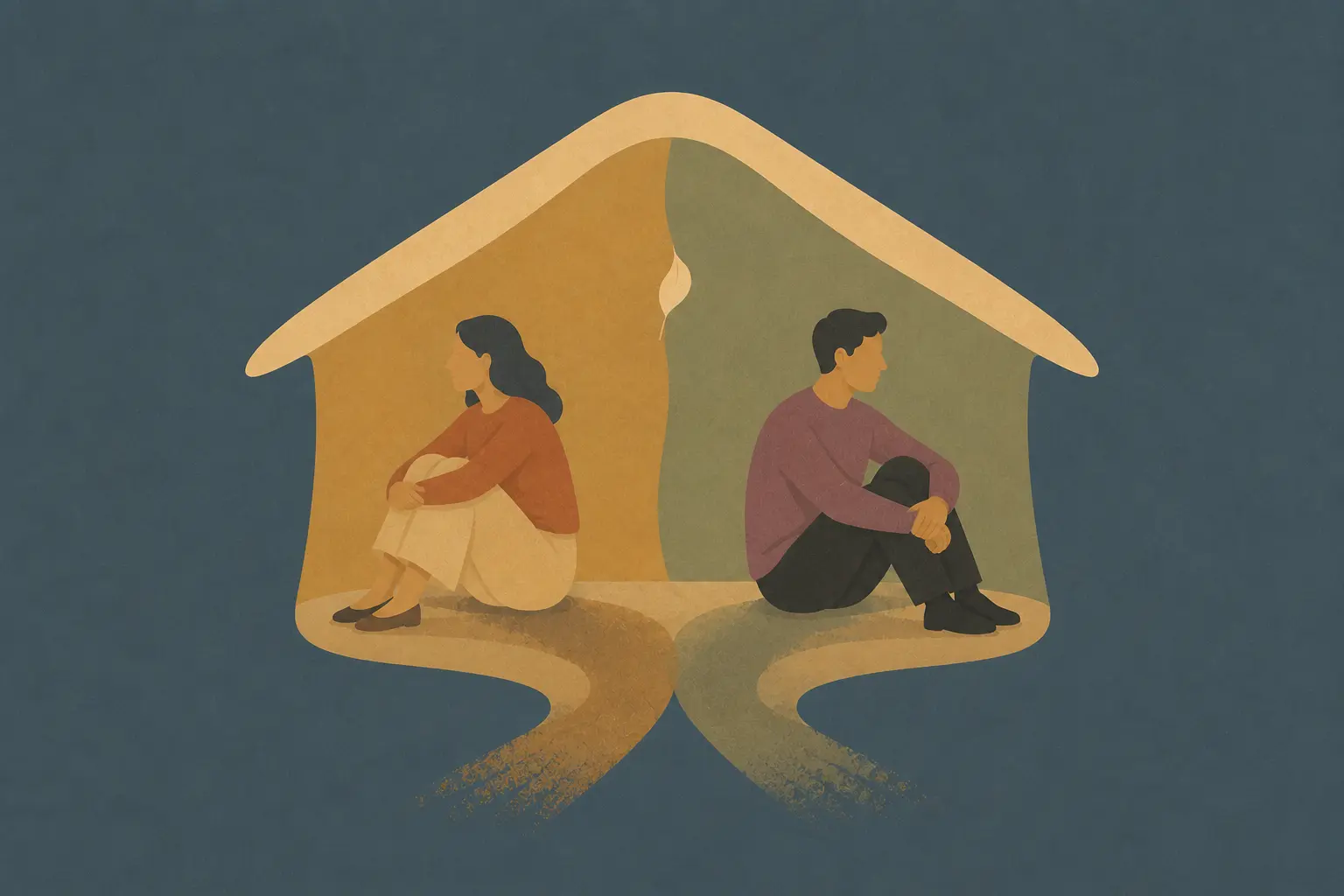
They have not separated. They still live together, shop together, and appear to others as a couple. But one has stopped making plans for the future. Looking at old photographs, they feel sadness as though describing something already over, rather than something that might end.
Grief is usually understood as a process that follows a loss. Yet in some relationships, loss is felt before any formal decision to separate. A partner is physically present, while trust, a shared future, sexual closeness, or the familiar form of the relationship may have gradually disappeared. Someone appears to be grieving something they still have.
Separation rarely happens in a single day
A 2025 study by Bühler and Orth, using four large longitudinal datasets, found a systematic decline in satisfaction as relationships approached separation. The researchers identified an initial slower decline followed by a sharper “terminal” phase beginning approximately seven months to two years and four months before separation. People initiating the breakup tended to enter this phase earlier than those receiving the decision.
This does not mean every relationship follows the same timetable. It does support the possibility that a breakup decision may be the final statement of a long internal unraveling. The difference between one person saying “It came out of nowhere” and the other saying “It had been ending for years” may reflect this gap in timing.
Ambiguous loss
Pauline Boss’s concept of “ambiguous loss” describes situations in which the boundaries of loss are unclear. It was originally developed around family experiences such as missing persons and dementia. It should not be applied mechanically to romantic relationships. Still, it can offer a useful framework for thinking about a partner who is physically present but psychologically unavailable.
The relationship is neither fully present nor clearly over. This uncertainty makes it difficult to name what is being grieved. Others may say, “But you’re still together.” The person feels that the old trust, shared dream, or familiar version of their partner is no longer there.
Grieving does not make separation inevitable
Being sad about something lost within a relationship does not necessarily mean wanting to leave. Sometimes a couple can establish a new form of relationship by acknowledging that the old arrangement has ended. Parenthood, illness, migration, repair after betrayal, or major life changes can make it impossible to restore the previous relationship exactly. Healing may require recognizing the loss and seeing what is possible under new conditions, rather than recreating the past.
But grief can also be part of postponing a decision. Someone remains attached to the relationship as it was years ago, sustaining the present bond solely through the possibility of that earlier version returning. At this point, “What have I lost?” needs a companion question: “What is actually here today?”
Two different timelines within one relationship
One of the hardest situations arises when one partner has been living with the loss for a long time while the other believes the process has only just begun. During a breakup conversation, the person making the decision may appear calmer or more distant. This does not always mean they do not care; they may have already experienced part of the grief. For the other person, the loss begins that day.
This difference does not entitle the person who grieved earlier to conceal unilateral decisions. Where the relationship is safe and free of violence, speaking sooner about loss and distance gives the other person a chance to share in the reality. Sometimes that conversation leads to repair; sometimes it allows both people to face the ending more honestly.
These questions may make the internal process clearer: What exactly am I grieving in this relationship? Have I lost my partner, who they used to be, who I was within the relationship, or the future we imagined? Am I holding on to the present bond, or to the possibility of the old one returning?
Grief for a relationship can begin before anyone says it is over. Sometimes tears are not a sign of the ending, but of a loss that has long gone unnamed finally becoming visible.
References
- Boss, P., & Yeats, J. R. (2014). Ambiguous loss: A complicated type of grief when loved ones disappear. Bereavement Care, 33(2), 63–69. https://doi.org/10.1080/02682621.2014.933573
- Bühler, J. L., & Orth, U. (2025). Terminal decline of satisfaction in romantic relationships: Evidence from four longitudinal studies. Journal of Personality and Social Psychology. Advance online publication. https://doi.org/10.1037/pspp0000551
- Rhoades, G. K., Kamp Dush, C. M., Atkins, D. C., Stanley, S. M., & Markman, H. J. (2011). Breaking up is hard to do: The impact of unmarried relationship dissolution on mental health and life satisfaction. Journal of Family Psychology, 25(3), 366–374. https://doi.org/10.1037/a0023627