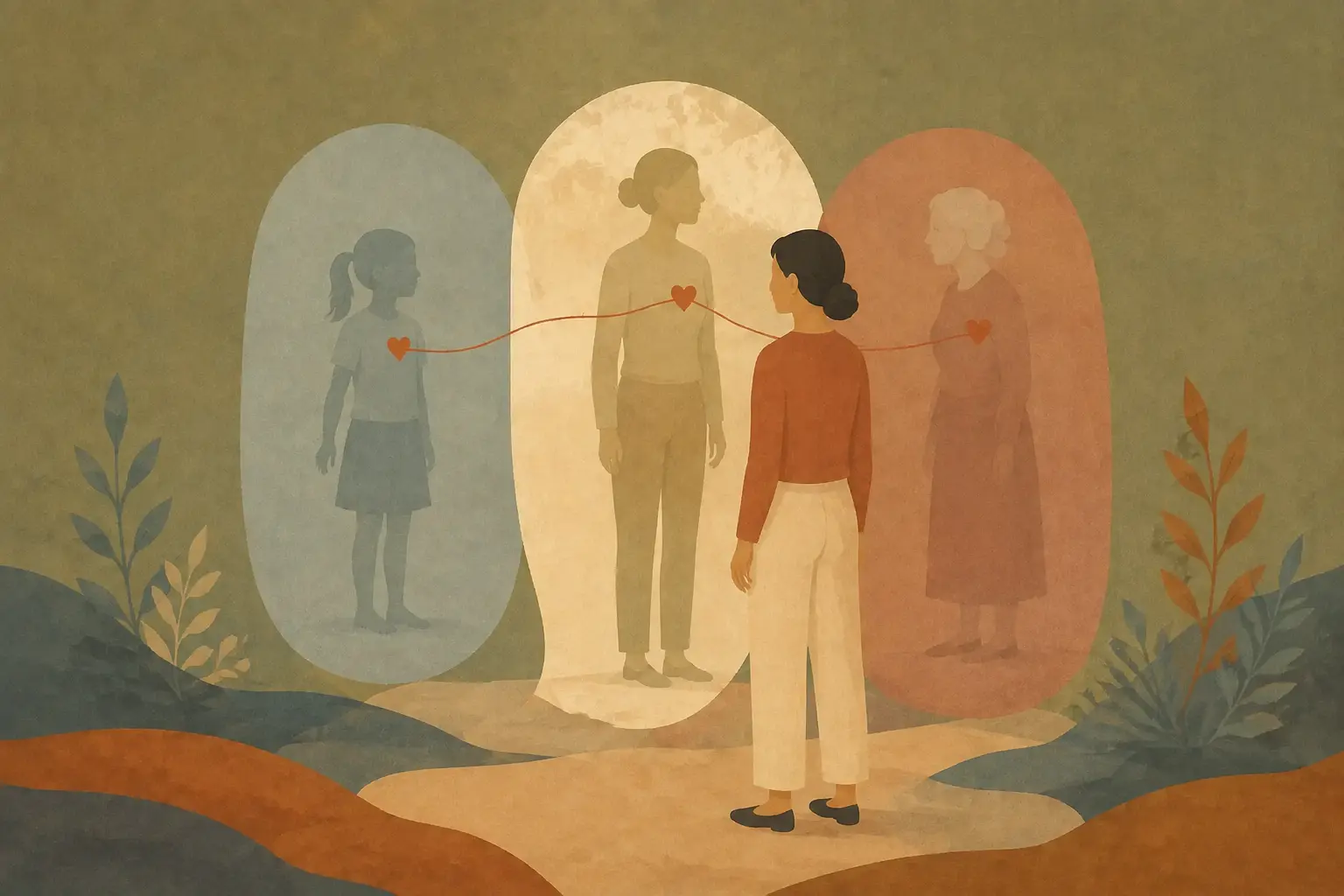
The face in the mirror is familiar, yet no longer the same. Illness, aging, pregnancy, weight change, or surgery has transformed the body. The person is trying to recognize their place in the world as well as their appearance.
When the body changes, how much does what we call “I” change?
The body is more than something we carry
Everyday language often treats the body as a container for the mind. Yet, as philosopher Shaun Gallagher (2005) emphasizes, we perceive, move, and become visible in relationships through it. Body image involves thoughts, feelings, and imagined judgments as well as a reflected shape. The literature collected by Cash and Pruzinsky (2002) likewise describes a multidimensional combination of perception, emotion, thought, and behavior rather than one image.
When change affects movement, sensation, or social responses, identity can be shaken. “I miss my old life, not just my old body” may express the experience. This grief is not superficial; it is a meaningful response to lost possibilities and a familiar self.
Proteus’s changing forms
The sea god Proteus in Homer’s Odyssey takes different forms; someone trying to hold him must persist through the transformations. The myth evokes the difficulty of fixing identity to one shape. Bodies change throughout life, and the image frozen as our “real body” is often a photograph of one period.
This does not mean every change must be loved. Acceptance does not beautify loss. It makes room for curiosity and care alongside the struggle with a new bodily reality.
The difference between appearance and experience
Bodies are often evaluated through how they look. Yet a body also feels and acts: breathing, holding, resting, walking, aching. Expanding attention from appearance toward function and sensation can make it a place lived in rather than only an object.
“What could my body do today?” and “Which care helped it?” do not dismiss aesthetic concerns. They prevent self-worth from being confined to one measure.
Continuity develops within change
Some aspects of the self change with the body; others find new forms. Values, relationships, and memories provide continuity, while adapting to new limits becomes part of identity. Recognizing our authority over our body matters alongside accepting that not every bodily outcome is controllable.
Bodily change does not make us wholly someone else, but neither does it leave us untouched. Healthy adaptation explores a meaningful life with today’s body rather than requiring a return to its former state.
Expanding our relationship with the body
If mirror-based judgment determines the whole day’s bodily experience, attention can widen through other channels. Warm water, stretching muscles, breathing rhythm, or fabric against skin can move the body from image to lived sensation. This is not an obligation to love your body, but practice in doing more than viewing it externally.
The social dimension needs discussion too. Others’ comments, even well intended, may intensify loss or intrusion. “I don’t want comments about my body” is a valid boundary. People can choose what to share, with whom, and when.
The comparison standard matters in adaptation. Continually competing with a years-old photograph can make natural change look like failure. Care, function, and quality of life within present circumstances offer a more useful measure. For medical changes, appropriate professional support avoids reducing bodily experience to willpower alone.
Getting to know the body again
- Am I missing only an appearance, or also earlier possibilities and a period of life?
- How did I experience my body today beyond evaluating it from outside?
- Which act of care supports health without punishment?
These questions do not deny bodily loss. They hold appearance, function, sensation, and identity together, opening a fuller space for adaptation.
References
- Cash, T. F., & Pruzinsky, T. (Ed.). (2002). Body image: A handbook of theory, research, and clinical practice. Guilford Press.
- Gallagher, S. (2005). How the body shapes the mind. Oxford University Press.
- Homer. (2003). The Odyssey (E. V. Rieu, Trans.; D. C. H. Rieu, rev.). Penguin Classics.