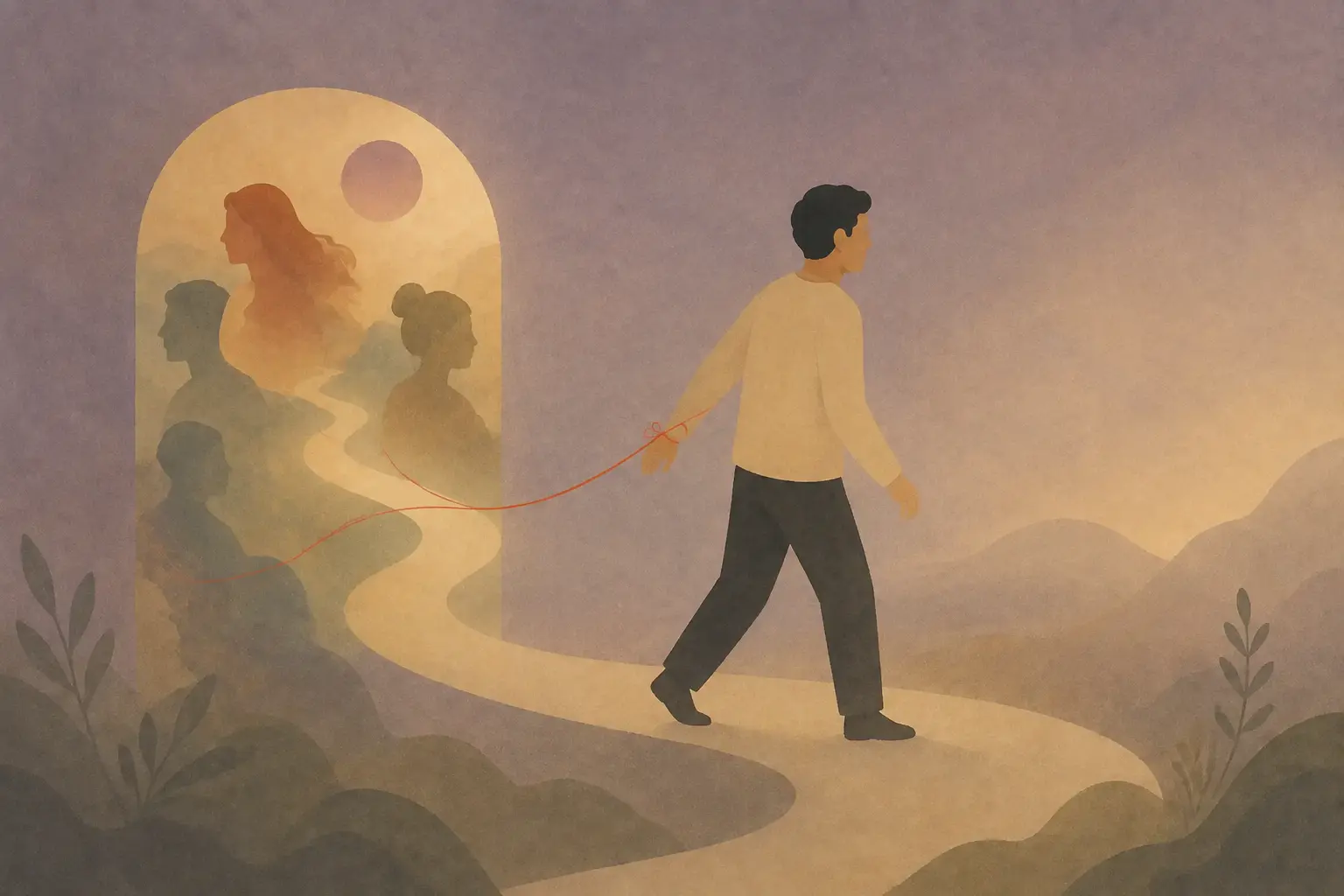
It is midnight. An ordinary remark from the day opens the door to an old argument. “If only I had said…” expands into decisions made years earlier. The body is in bed, but the mind keeps wandering through a room in the past.
If the past cannot change, why does the mind repeatedly return to it?
The mind seeks closure, not just an outcome
Thinking about the past is not always a problem. Making sense of events, learning from experience, and recognizing our part can be useful. But when thought keeps replaying scenes without a new perspective or action, it may become rumination. It appears to seek a solution while keeping us circling the same questions. Nolen-Hoeksema and colleagues (2008) describe this repetitive, unresolved thinking and its association with depression.
A need for control may underlie the cycle. “If I find exactly where I went wrong, I won’t be hurt again” turns the past into a safety project. Yet some events have no single cause, perfect explanation, or remedy. Instead of tolerating uncertainty, the mind reopens the file.
Why did Orpheus look back?
In Ovid’s Metamorphoses, Orpheus accepts one condition for bringing his dead wife Eurydice out of the underworld: he must not look back until reaching the surface. Near the exit, doubt overtakes him and he turns. He loses her a second time.
Reading this only as punishment for curiosity is incomplete. His glance expresses a wish to know that what we love is still there. Returning to the past can likewise be an attempt to briefly confirm a lost person, possibility, or former self. Beneath looking back is not only weakness, but a human wish for connection to continue.
Remembering and reliving are different
Memory does not function like a filing cabinet. Each recall reconstructs an experience with present feelings and knowledge. Returning to the past therefore does not always reveal its bare truth. Today’s anxiety may darken an old scene; today’s compassion may give it another meaning.
Constructive reflection asks concrete questions: “What did this teach me?” “Which need do I recognize today?” “What small step can I take now?” Circular thought is often abstract and judgmental: “Why am I always like this?” “How could I have done that?” The first opens possibilities; the second keeps us in our own courtroom. Edward Watkins’s (2008) review distinguishes potentially constructive, concrete, process-focused repetition from damaging abstract, evaluative thinking.
Changing our relationship with the past
The aim is not to erase the past, but to reduce its sole authority over present life. When a loop begins, ask: Am I solving something, or repeating pain? If a problem can be addressed, choose a concrete action: apologizing, setting a boundary, finding information, or writing. If the loss cannot be solved, the need may be grief and acceptance rather than a solution.
Looking back belongs to being human. But when the traces behind us alone determine our direction, today becomes invisible. Orpheus’s story invites us to consider each glance’s meaning and cost, rather than simply forbidding it. We can carry the past without living inside it.
Different reasons for returning
The same recurring thought can serve different needs. Someone may want responsibility for a mistake, to keep a lost possibility alive, or to understand a present feeling’s origin. Before asking whether thinking about the past is harmful, consider its function. If it leaves us clearer, more compassionate, and ready to act, processing may be occurring. If each return leaves greater helplessness and guilt, a loop may have formed.
Instead of issuing a strict “Don’t think,” a defined time for reflection can be set aside. A thought arriving during the day is briefly noted and postponed, then examined in writing during that period. A concrete activity afterward returns attention to the present. The past is neither expelled entirely nor allowed to occupy the whole day.
The language of counterfactual thinking can also change. “I didn’t have today’s knowledge then” can replace “If only I had known.” “I contributed to these consequences of that decision” can replace “I ruined everything.” Both responsibility and reality remain. Learning does not require judging our past self with all the knowledge available now.
A pause between past and present
- Is this thought offering new information or repeating the same verdict?
- What can no longer change, and what can I repair today?
- Which valued experience could I return to if I set the memory down for a while?
The aim is not an immediate correct answer, but an observing position within the loop. The past may return. We need not go with it every time.
References
- Nolen-Hoeksema, S., Wisco, B. E., & Lyubomirsky, S. (2008). Rethinking rumination. Perspectives on Psychological Science, 3(5), 400–424. https://doi.org/10.1111/j.1745-6924.2008.00088.x
- Ovid. (2004). Metamorphoses (D. Raeburn, Trans.). Penguin Classics.
- Watkins, E. R. (2008). Constructive and unconstructive repetitive thought. Psychological Bulletin, 134(2), 163–206. https://doi.org/10.1037/0033-2909.134.2.163