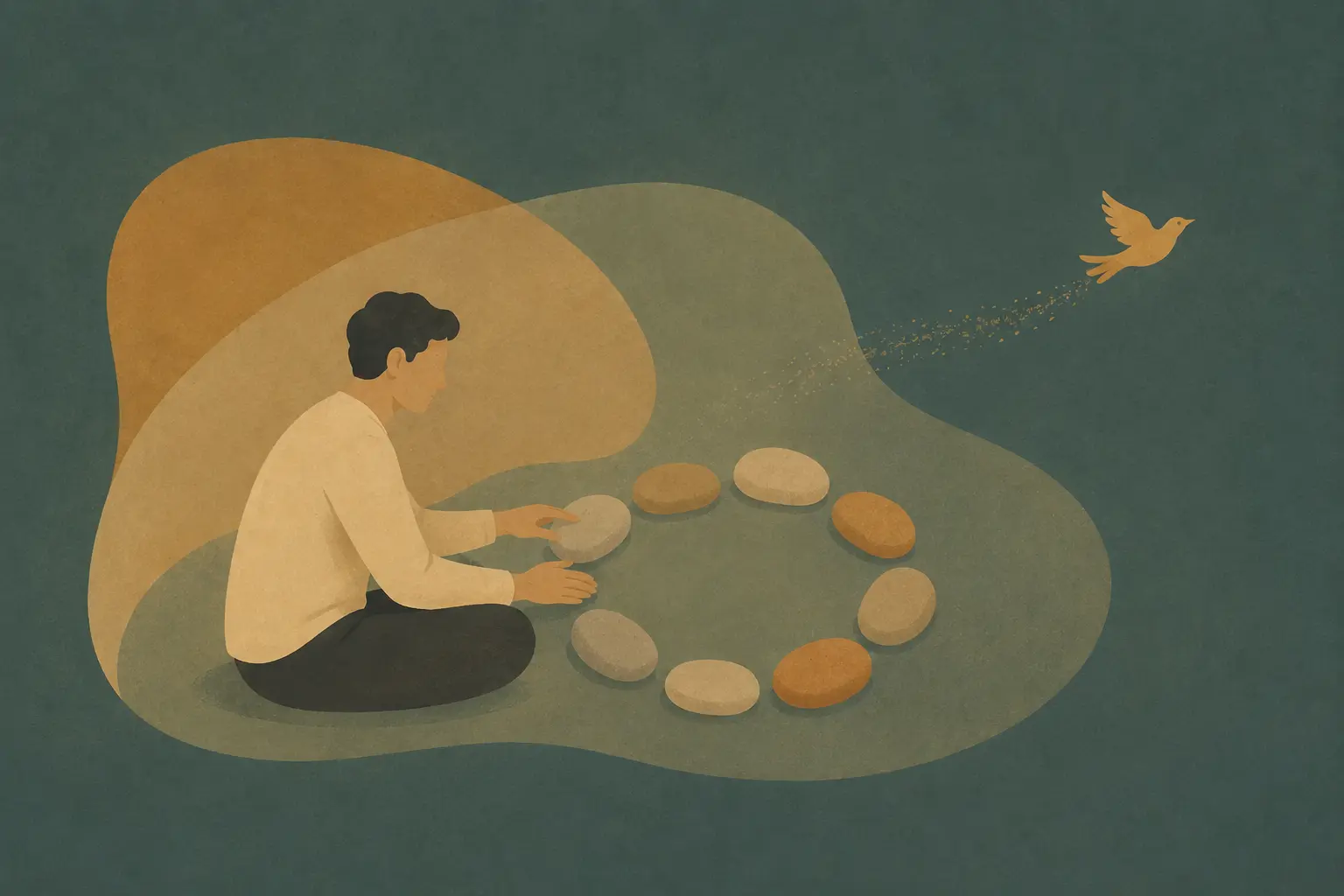
Before a trip, they check the weather three times, print every reservation, and prepare alternative routes. Still, they leave home uneasy. New questions emerge: What if the flight is canceled? What if they become ill? What if something unforeseen happens?
Why does anxiety not always decrease as control increases?
Control can provide a sense of security
Planning, assessing risks, and preparing are useful skills. Difficulty begins when control stops being a tool and becomes an attempt to eliminate uncertainty entirely. The mind may interpret the unknown as threatening. As tolerance for uncertainty decreases, people may seek relief through more control. Carleton (2016) proposes that fear of the unknown may be a shared core underlying many forms of anxiety.
But not every variable in life is controllable. When each check brings brief relief, the mind may learn, “Without checking, there would have been danger.” Relief reinforces the behavior, and more may be needed next time. The search for safety quietly becomes fuel for anxiety.
The prophecy Oedipus could not escape
In Sophocles’s Oedipus Rex, both Oedipus and his family act to prevent a feared prophecy. Their precautions ultimately become parts of the route through which it is fulfilled. The tragedy’s force lies not simply in human powerlessness, but in the illusion of complete control.
The story need not recommend fatalism. It makes the limits of knowing and controlling visible. Sometimes what we do to prevent danger narrows life, placing the very possibility we avoid at the center of our behavior.
Influence and the wish for command
Softening the need for control does not mean becoming passive. It means distinguishing what can and cannot be done. This is also Epictetus’s central Stoic distinction: some things are up to us and others are not. We may influence our intentions, preparation, and responses, without having complete command over others’ thoughts, the past, or every outcome.
Three columns can help in daily life: “What I can control,” “What I can influence,” and “What I need to accept.” The first calls for action, the second effort and flexibility, and the third the ability to carry uncertainty’s feelings.
Trust is not certainty
A realistic sense of security does not mean believing nothing bad will happen. It involves trusting our capacity to cope with the unexpected. We can deliberately allow small uncertainties: not rereading a message, letting someone else manage a minor plan, or waiting without a definite answer. The aim is not danger, but experiencing discomfort rise and then diminish. Grupe and Nitschke’s (2013) review emphasizes how inflated threat anticipation and avoidance can feed anxiety around uncertainty, and how tolerating uncertainty can loosen that cycle.
We can ask: Does this preparation serve a real need, or a search for certainty? Control is valuable when it prepares us for life. When life cannot begin until everything is certain, it produces a shrinking world rather than security.
Testing the function of control
Looking at what follows a behavior can help distinguish useful control from anxiety-driven checking. Locking a door once provides security; checking it a fifth time may add no information while providing temporary relief. If preparation is complete but the mind still says “Once more,” the difficulty may concern uncertainty more than risk.
Small experiments can teach this through experience: deciding without complete certainty in a low-risk matter, leaving a task at “good enough,” or not intervening in someone’s different method. Notice whether anxiety rises and then falls without intervention. These exercises do not involve violating genuine safety rules.
Control can also have relational costs. Constant correction and reminders, however well intended, may communicate mistrust. “Am I reacting because the outcome is different, or because it is dangerous?” offers guidance. Sometimes the missing part of safety is permission for others to take responsibility, rather than a better plan.
Approaching uncertainty
- Am I managing an actual risk or an uncomfortable uncertainty?
- What do I predict will happen if I do not check again?
- What resources could help if the outcome is not what I want?
These questions place control in its proper role rather than removing it entirely. Acting where we have influence and noticing the cost of certainty-seeking where we do not can support a more balanced security.
References
- Carleton, R. N. (2016). Fear of the unknown: One fear to rule them all? Journal of Anxiety Disorders, 41, 5–21. https://doi.org/10.1016/j.janxdis.2016.03.011
- Epictetus. (2014). Discourses, fragments, handbook (R. Hard, Trans.). Oxford University Press.
- Grupe, D. W., & Nitschke, J. B. (2013). Uncertainty and anticipation in anxiety. Nature Reviews Neuroscience, 14(7), 488–501. https://doi.org/10.1038/nrn3524
- Sophocles. (1984). The three Theban plays (R. Fagles, Trans.). Penguin Classics.