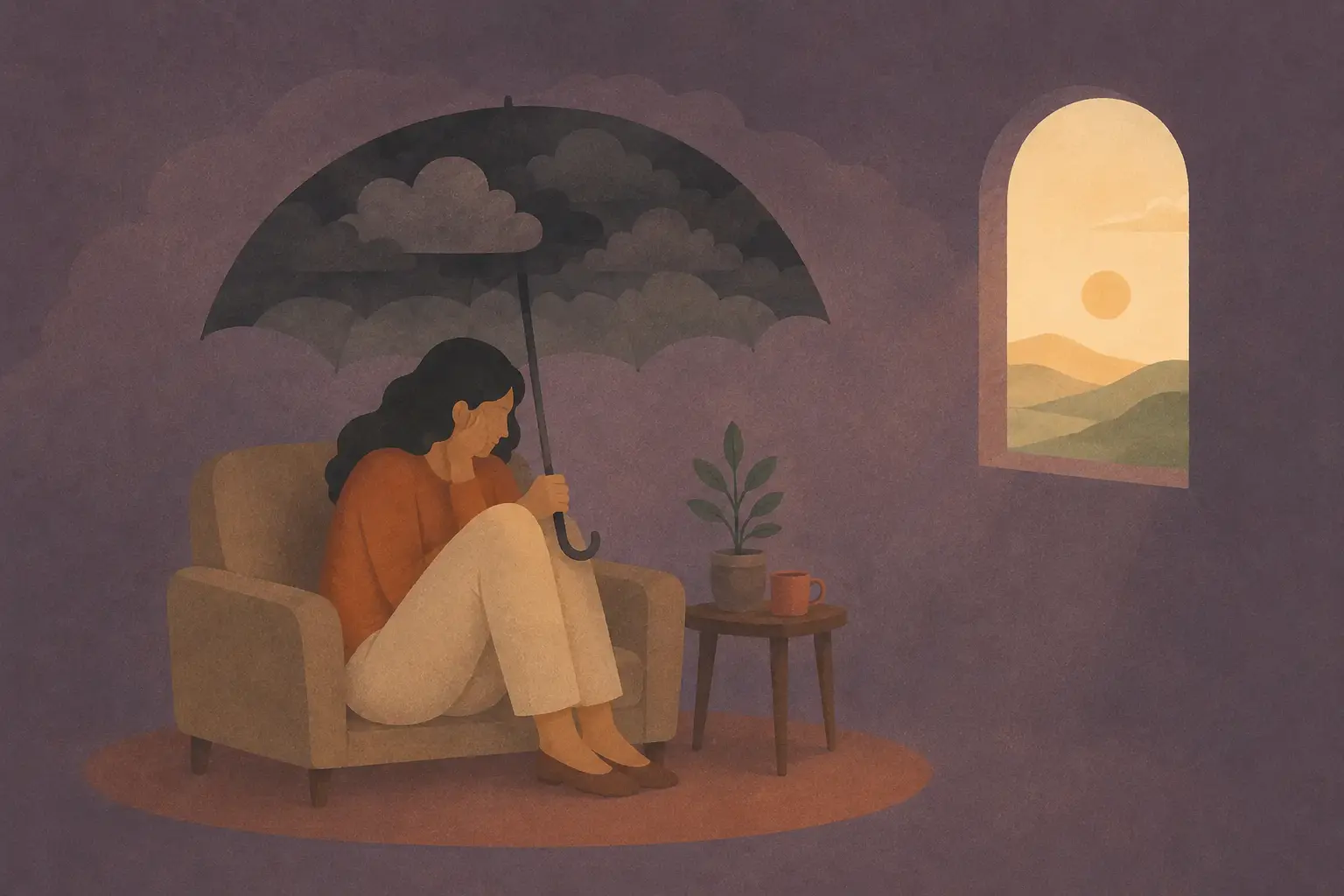
A late-night phone call first suggests bad news. A child arrives a few minutes late and the mind imagines accidents. Before a meeting, every embarrassing possibility is listed. The person calls it being prepared, but preparation never finishes.
Does anticipating the worst protect us, or make us experience pain in advance?
Anxiety’s protective roots
Anxiety is not entirely unnecessary. It helps us notice possible dangers, take precautions, and plan. But when possibility and certainty become confused, “might happen” begins to feel like “will happen.” The body may respond to an event that has not occurred as though it were real. Carleton (2016) describes fear of the unknown as a possible common foundation of multiple anxieties; a mind experiencing uncertainty as threat can turn “might” into “will.”
Worry can be used as emotional insurance: “If I imagine the worst, I won’t be caught unprepared.” Yet repeated rehearsal does not necessarily improve coping with consequences. It often drains attention and energy, making even safe present moments feel threatened. Grupe and Nitschke’s (2013) review describes exaggerated anticipation of potential threat; taken too far, anticipation becomes a burden on coping capacity rather than preparation.
Cassandra’s endless warning
Appearing in Homer’s Iliad as a daughter of Troy, Cassandra becomes in later accounts a prophet whose visions no one believes. Her story symbolizes real danger going unheard. Today’s anxious mind may instead keep its inner Cassandra continually speaking, treating every possibility as prophecy and every bodily signal as evidence.
The important distinction is between a warning and a continuous alarm. A warning identifies a particular danger and an actionable precaution. The continuous alarm changes targets without switching off. One generates action; the other sustains the pursuit of certainty.
Probability, impact, and coping
Three questions can help evaluate a worry: How likely is this event? What would its impact be? What resources could help me cope? Anxious thought often enlarges the first two and minimizes the third.
A real risk can receive a concrete plan: a health check, a safety precaution, or preparation for a meeting. If mental repetition continues after the plan is complete, it may no longer add information. At that point, returning attention to the body and surroundings and naming the thought “a possible scenario” may help.
Being prepared does not require continual suffering
Tolerating uncertainty does not mean persuading ourselves that nothing bad will happen. It means being able to say, “I cannot know everything that will happen. I have done what I can for now.” This includes both realism and a limit.
Thinking about the worst may begin a protective plan. When thinking replaces precaution, however, it brings anticipated suffering into today. Security lies in trusting our ability to act when necessary while remaining connected to the present, rather than pre-living every possible disaster.
Distinguishing worry from problem-solving
Problem-solving is specific, bounded in time, and action-oriented. “I will rehearse the first three minutes of tomorrow’s presentation” is a plan. “What if I humiliate myself?” is worry with no definite endpoint. One can be completed; the other produces another “what if” after every answer.
When worry begins, divide a page in two: write the evidenced risk on the left and a feasible action on the right. If there is no action, this may be a possibility that cannot be solved now. The task then becomes carrying uncertainty for a while rather than finding an answer.
Brief records can update anxious predictions with real information: What was feared? How likely did it seem? What happened? How well could we cope? Over time, the mind notices predictions that did not occur as well as fears that did. The exercise does not belittle anxiety; it separates probability from prophecy again.
Possibility instead of prophecy
- Is the feared event a possibility, or is it happening now?
- What single precaution can I take, and when will it count as complete?
- What are two more likely outcomes besides the worst case?
When anxiety demands certainty, these questions reopen the range of possibilities. They do not remove the mind’s ability to imagine danger; they prevent it from becoming the only narrator.
References
- Carleton, R. N. (2016). Fear of the unknown: One fear to rule them all? Journal of Anxiety Disorders, 41, 5–21. https://doi.org/10.1016/j.janxdis.2016.03.011
- Grupe, D. W., & Nitschke, J. B. (2013). Uncertainty and anticipation in anxiety. Nature Reviews Neuroscience, 14(7), 488–501. https://doi.org/10.1038/nrn3524
- Homer. (2003). The Iliad (E. V. Rieu, Trans.; P. Jones, rev.). Penguin Classics.