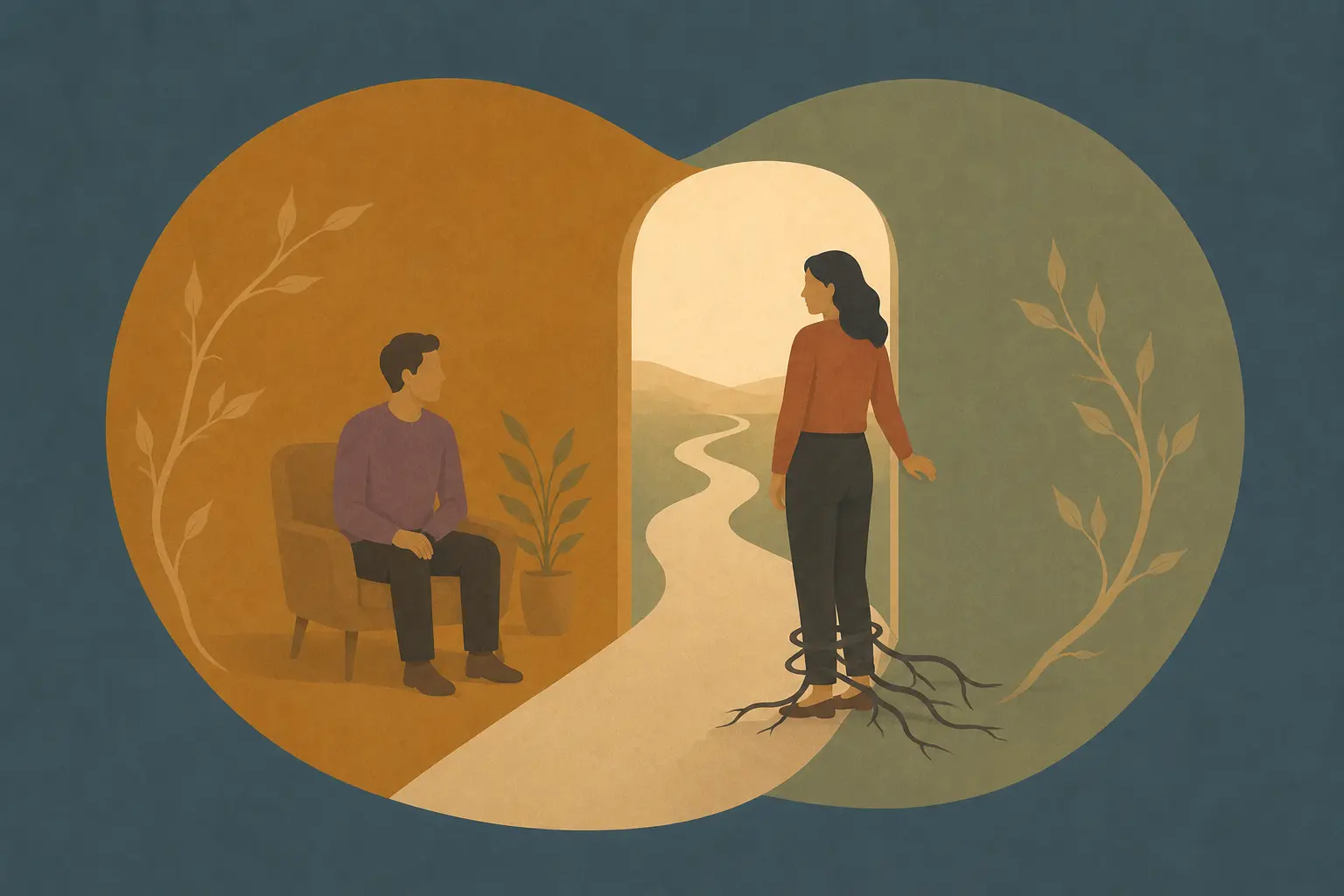
For a long time, they have felt they no longer want the relationship. Yet they do not say they want to separate. They call less, postpone plans, and let arguments grow. Secretly, they wait for their partner to tire and say, “This isn’t working.” The separation will happen, but they will not have made the decision.
Someone who wants to end a relationship is not always the person who openly leaves. Sometimes they try to place the burden of deciding on their partner. Ambivalence may be involved, as may guilt, fear of being a bad person, difficulty witnessing the other’s pain, and avoidance of responsibility for consequences.
The distance between wanting and deciding
Thoughts of leaving rarely consist of one feeling. Joel and colleagues’ studies suggest that people questioning relationships can hold strong reasons both to stay and to leave. Love, shared history, habit, and concern for a partner’s well-being can coexist with conflict, mistrust, and unmet needs.
“Why can’t I leave if I want to?” therefore does not always have the answer “lack of willpower.” A person may be caught between two realities. But when unspoken ambivalence seeps into behavior for a long time, their partner begins paying the cost of uncertainty.
Considering a partner’s well-being
Samantha Joel and colleagues’ 2018 research suggested that breakup decisions involve not only personal satisfaction, but also perceptions of how committed a partner is and how much separation would hurt them. Staying is not always selfish or cowardly. People may not want to cause someone they love pain.
Yet an intention to protect can have the opposite effect when it becomes months of emotional withdrawal. Without understanding, the partner may try harder, blame themselves, or struggle to interpret diminishing closeness. An explicit breakup hurts; an ambiguous, one-sided unraveling can also undermine trust in one’s own reality.
Making the other person decide
Sometimes someone makes the relationship increasingly unlivable while waiting for their partner to leave. They become cold, criticize more, withdraw from responsibilities, or act openly hurtfully. Eventually, they can be the person who was “left,” escaping some guilt.
In existential philosophy, Sartre discusses ways people evade the responsibility that comes with freedom. Experiencing our own choice as if it were imposed by circumstances or someone else can temporarily lighten its burden. Yet not deciding is also a decision with effects on the relationship.
This perspective is not advice for unsafe relationships. If violence, threats, or stalking are possible, separation need not involve direct confrontation; safety planning and professional support come first.
Postponement is more than an internal wait. Withdrawing while continuing ordinary closeness creates a gap between words and behavior. A partner sees warmth at some moments and clear distance at others, unsure which information to trust. This fluctuation can erode trust independently of the possibility of separation. Speaking about uncertainty does not require an immediate final decision; it lets both people know the reality they are living in.
Honesty need not wait for complete certainty
A breakup conversation does not require certainty that there will never be regret. Honesty may be less “I definitely feel nothing” than “For a long time, I’ve been questioning whether I want to stay, and I don’t want to withdraw while hiding that from you.”
If the decision remains unclear, a defined period of reflection, couples therapy, or an open conversation may be considered instead of quietly undermining the relationship. These must not become mere instruments for postponing responsibility either.
We can ask: Which feeling am I avoiding while waiting for my partner to decide? What will I believe about myself if I am the one who leaves? Am I holding on to the relationship, or to avoiding guilt?
It is not always possible to avoid hurting someone. It is possible to avoid leaving them in uncertainty, diminishing them until they leave, or refusing responsibility for our choice. Saying the relationship is ending cannot remove all pain, but it may avoid adding an unnecessary loss of trust in reality.
References
- Joel, S., MacDonald, G., & Page-Gould, E. (2018). Wanting to stay and wanting to go: Unpacking the content and structure of relationship stay/leave decision processes. Social Psychological and Personality Science, 9(6), 631–644. https://doi.org/10.1177/1948550617722834
- Joel, S., Impett, E. A., Spielmann, S. S., & MacDonald, G. (2018). How interdependent are stay/leave decisions? On staying in the relationship for the sake of the romantic partner. Journal of Personality and Social Psychology, 115(5), 805–824. https://doi.org/10.1037/pspi0000139
- Le, B., & Agnew, C. R. (2003). Commitment and its theorized determinants: A meta-analysis of the investment model. Personal Relationships, 10(1), 37–57. https://doi.org/10.1111/1475-6811.00035