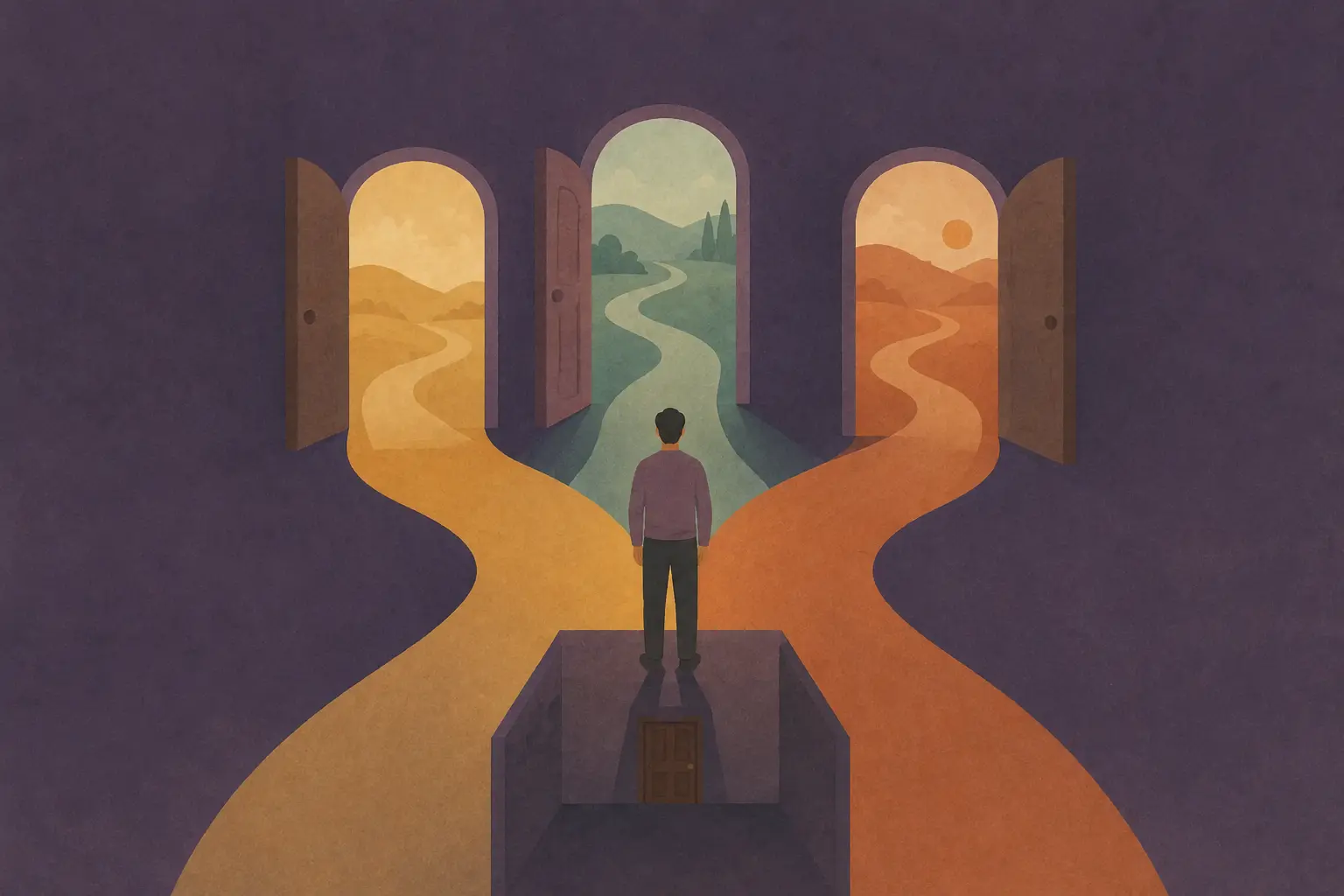
The menu is long and the options appealing. Even after deciding, someone keeps looking at other pages. With larger choices, this can last months: change jobs, cities, or relationships? Open options look like freedom, yet life becomes a waiting room.
Why can freedom to choose make movement harder?
Every choice involves giving something up
Choosing means taking one possibility and letting others go, at least for now. Beneath indecision may lie fear of grieving unlived lives as well as fear of a wrong decision’s consequences. Keeping doors open postpones this loss.
But not choosing has consequences too. Time passes, circumstances change, and some options close by themselves. Avoiding responsibility for deciding can mean leaving the decision to time.
Buridan’s ass and modern abundance
In the philosophical story of Buridan’s ass, a donkey starves because it cannot choose between two equal hay bales. Although the story is not historically found in Buridan’s own text, it vividly illustrates a problem of will and decision: waiting for a perfect reason can halt action.
More options do not always bring greater satisfaction in modern life. Numerous alternatives increase comparison demands, and “Was there something better?” may persist afterward. The difficulty is experiencing freedom as an obligation to choose without error, rather than freedom itself. In Iyengar and Lepper’s (2000) experiments, participants offered fewer options both chose more often and reported greater satisfaction with their choices.
Existential anxiety
Kierkegaard describes anxiety as the dizziness of freedom. Realizing we can choose also reveals our part in our life’s direction. This is both possibility and weight. No choice guarantees the entire future; deciding involves responsibility within uncertainty.
“Which value do I want to move toward?” may be more useful than “Which option is absolutely right?” Values do not guarantee outcomes, but provide direction. Reversible and irreversible decisions also need distinguishing. Most everyday choices are less final than the mind portrays them.
A good-enough choice
A deadline, a few central criteria, and a limit on information gathering can reduce endless comparison. Stopping research into alternatives after choosing gives the decision room to be lived. A good choice is not only discovered at the beginning; effort, adjustment, and meaning also build it over time.
Freedom does not mean keeping every door open forever. It can mean owning the doorway we take and changing direction with new information when needed. Decision anxiety reminds us that freedom carries responsibility rather than proving we are unfree.
A process that can carry a decision
For an important choice, distinguish irreversible consequences from correctable ones. Changing jobs may be difficult without being absolute; some health and legal decisions require more careful advice. Seeing the actual weight prevents every choice from feeling equally enormous.
Values can narrow options. Identify three main criteria, such as learning, financial sustainability, and close relationships. Evaluating against these rather than dozens of details may reduce comparison fatigue. Criteria may conflict; most adult decisions offer no perfect gain.
Possible regret can be acknowledged from the outset. The unchosen path’s attractiveness is not proof that the chosen one was wrong. Every choice contains a loss. Owning a decision means turning the selected path into actual experience despite doubt, rather than never doubting.
At the threshold of choice
- Which parts of this decision are reversible, and which are not?
- Setting fear aside, what are my three most important criteria?
- What will continued indecision cost six months from now?
Deciding is not knowing the future. It is accepting responsibility within available information, values, and limits. An unexpected outcome does not prove that the original decision process was wholly wrong.
References
- Iyengar, S. S., & Lepper, M. R. (2000). When choice is demotivating: Can one desire too much of a good thing? Journal of Personality and Social Psychology, 79(6), 995–1006. https://doi.org/10.1037/0022-3514.79.6.995
- Kierkegaard, S. (1980). The concept of anxiety (R. Thomte & A. B. Anderson, Trans.). Princeton University Press.