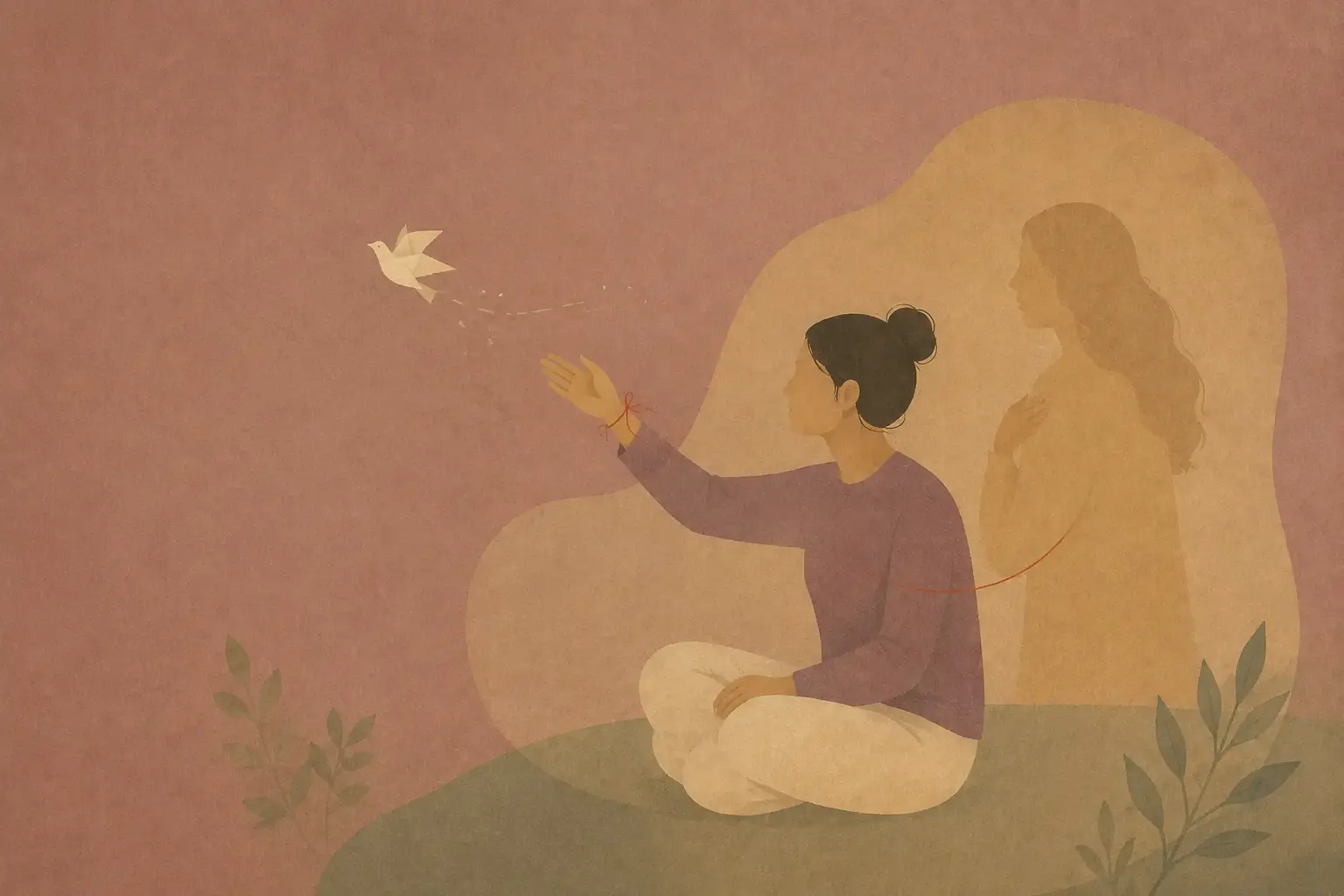
One day, someone notices themselves laughing. Guilt follows immediately: “How can I be enjoying myself?” Every moment in which they think less about the person they lost feels as though a little more of their bond might disappear.
Does loyalty mean continuing to grieve, or returning to life?
Grief is not a task of forgetting
Grief is the process of finding a place for a loved one’s absence within our mental and emotional world. It can involve both turning toward the loss and returning to life. One day, a person may be immersed in memories; another day, occupied with ordinary tasks. This fluctuation is part of adapting, not evidence of a lack of love. Stroebe and Schut’s (1999) dual process model describes precisely this: bereaved people move between loss-oriented and restoration-oriented coping. Adaptation involves movement between them rather than remaining in just one.
Grief has no single correct timetable. The pressure that “It should be over by now” can be as constricting as the belief “If my pain decreases, our bond will weaken.” The intensity of pain is not a reliable measure of love.
Orpheus’s second loss
In Ovid’s Metamorphoses, Orpheus looks back while leading Eurydice out of the underworld and loses her again. Love’s backward glance is also the moment separation becomes final. A grieving person may likewise keep returning to the past to preserve the bond; looking ahead can feel like leaving their loved one behind.
Yet the form of a bond can change. When physical togetherness ends, memories, values, rituals, and inner conversations can sustain a “continuing bond.” This does not deny the loss; it acknowledges the relationship’s new reality. Klass, Silverman, and Nickman’s (1996) edited volume established this approach in the literature as “continuing bonds”: healthy grief can involve transforming the bond rather than severing it.
Pain and connection are not the same
“I love them through my suffering” is an understandable thought. Early on, pain may feel like the most vivid place where the person can still be reached. Over time, love can be carried in other ways: continuing something they valued, sharing their memory, creating rituals on particular days, or keeping alive a quality they brought into our lives.
This transformation is not forgetting. It creates a living legacy in place of a frozen image. Laughing, forming new bonds, or investing in the future does not cancel past love.
Allowing both movements of grief
Some days may call for approaching the grave, photographs, or memories; others for stepping away and resting. Both movements belong to grief. Asking “Do I need to turn toward the loss today, or toward life?” may soften rigid expectations.
Professional support is important if pain remains unbearable for a long time, daily functioning is substantially affected, or a person struggles to stay safe.
We do not have to abandon the person we love. We learn to relate to the reality that they are no longer here. Returning to life is not betrayal. Sometimes it is the only way to carry into the future what their love left within us.
Deliberately shaping the bond
A grieving person can choose small rituals for when and how the bond continues. They might prepare a loved one’s dish on a particular day, make a memory box, tell a family story about them, or make a meaningful contribution in their name. A ritual offers a place for memory within life, rather than leaving it to overflow at every moment.
There is no single right approach to belongings either. Putting them away immediately, preserving them for a long time, or repurposing some may mean different things to different people. Decisions should reflect the person’s needs and capacity to cope, rather than outside pressure that “It’s time.” Knowing that some decisions can be temporary may be reassuring.
People nearby often do not know what to say. Where possible, the grieving person can make their need concrete: “I want you to listen without suggesting solutions,” or “Today I need to talk about something ordinary.” Living with loss involves reshaping not only the bond with the person who died, but also support from those still living.
Continuing the bond in another form
- Why do I equate less pain with less love?
- Which of this person’s values can I carry forward?
- Do I need to approach the loss today, or draw some support from life?
The answer can change each day. Looking at photographs one day and laughing with friends the next can exist within the same bond. Fluctuation is the rhythm of adaptation, not indecision.
References
- Klass, D., Silverman, P. R., & Nickman, S. L. (Ed.). (1996). Continuing bonds: New understandings of grief. Taylor & Francis.
- Ovid. (2004). Metamorphoses (D. Raeburn, Trans.). Penguin Classics.
- Stroebe, M., & Schut, H. (1999). The dual process model of coping with bereavement. Death Studies, 23(3), 197–224. https://doi.org/10.1080/074811899201046