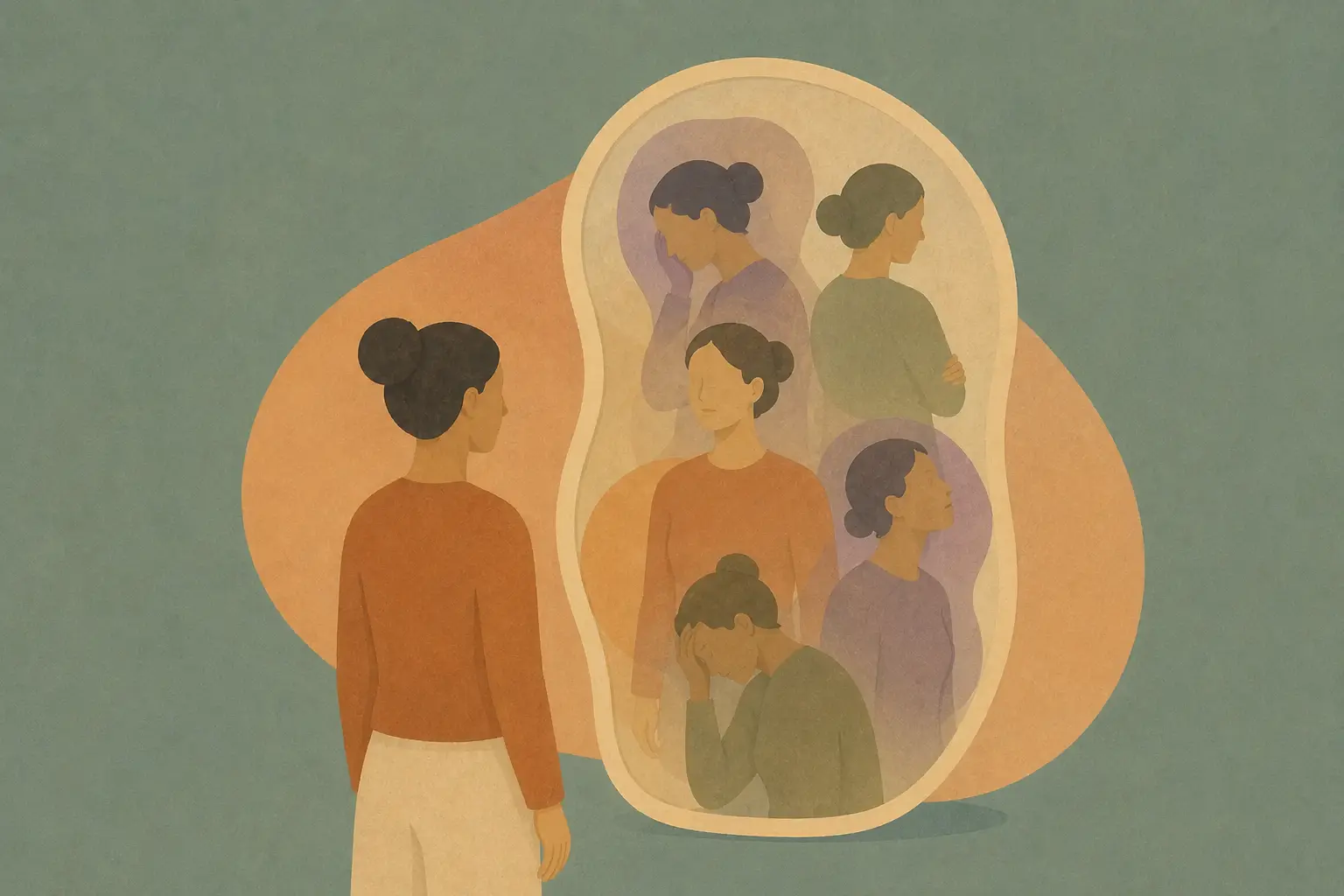
They describe themselves as patient. One day, they notice envy at a close friend’s success. More than the feeling, its meaning about themselves hurts: “So I’m not who I thought I was.”
Why does self-knowledge bring unease as well as insight?
The self seeks consistency
We build stories about ourselves: good, hardworking, calm, independent, fair. These provide continuity. When feelings or behavior contradict the story, discomfort appears. The mind may reduce it by minimizing behavior, blaming circumstances, or ignoring new information. Leon Festinger’s (1957) cognitive dissonance theory describes the tension among incompatible beliefs and actions and the mind’s attempts to reduce it.
Knowing ourselves means more than listing preferred qualities. It includes the gap between intentions and effects, defenses, and needs we would rather not see. Insight can therefore feel threatening to self-esteem.
Narcissus’s limited mirror
In Ovid’s Metamorphoses, Narcissus becomes attached to his reflection in water. Usually read as excessive self-love, the story also matters for the reflection’s one-dimensionality. He relates to a fixed image rather than a living, changing, relational self.
Knowing ourselves only through an ideal image can similarly alienate us from lived experience. Actual selves contain contradictions: compassionate people become angry, brave people feel fear, generous people feel envy. A feeling’s presence is not the entirety of character.
Separating information from judgment
“I feel envy” is an observation; “I am a bad person” is a verdict. Observation invites curiosity about needs, losses, or comparisons. Judgment closes inquiry. Self-knowledge means seeing an impulse before it becomes action, rather than endorsing every impulse.
Wilson and Dunn’s (2004) review emphasizes self-knowledge’s limits. People cannot directly know every cause of their behavior; sometimes persuasive explanations are constructed afterward. Feedback, behavioral patterns, and context therefore matter alongside inner certainty.
Turning discomfort into room for growth
Before defending against an unfamiliar aspect of ourselves, we can pause: What concrete example supports this information? Is it one moment or a recurring pattern? What can I do now in line with my values? Insight becomes information for choosing rather than punishment of identity.
Self-knowledge is not finding a finished portrait. It is continuing to meet a changing, contradictory being shaped in relationships. Discomfort may show that an old story no longer carries the whole truth rather than that we are on the wrong path.
Exploring blind spots safely
Knowledge of ourselves comes from more than introspection. Concrete feedback from a few trusted people can reveal gaps between intention and effect. “Are there moments when I don’t listen during arguments?” is more usable than “What do you think I’m like?”
Feedback need not be immediately accepted or rejected. We can ask for an example, consider different contexts, and look for recurrence. One person’s view is not absolute truth, but may provide a window our own story overlooks.
Humor and compassion matter too. Seeing contradictions does not require a solemn moral tribunal. “So there is this side of me too” allows responsibility and flexibility. Knowing every aspect of ourselves is impossible; maturity can include tolerating that uncertainty.
Approaching a blind spot
- Is what I noticed a behavior, a recurring pattern, or a verdict about identity?
- Which choice could this information improve instead of becoming self-punishment?
- Which feedback about me is difficult to hear without becoming defensive?
Knowing ourselves is not capturing an unchanging essence. It involves noticing what emerges in new situations and deciding how to act with that knowledge.
References
- Festinger, L. (1957). A theory of cognitive dissonance. Stanford University Press.
- Ovid. (2004). Metamorphoses (D. Raeburn, Trans.). Penguin Classics.
- Wilson, T. D., & Dunn, E. W. (2004). Self-knowledge: Its limits, value, and potential for improvement. Annual Review of Psychology, 55, 493–518. https://doi.org/10.1146/annurev.psych.55.090902.141954