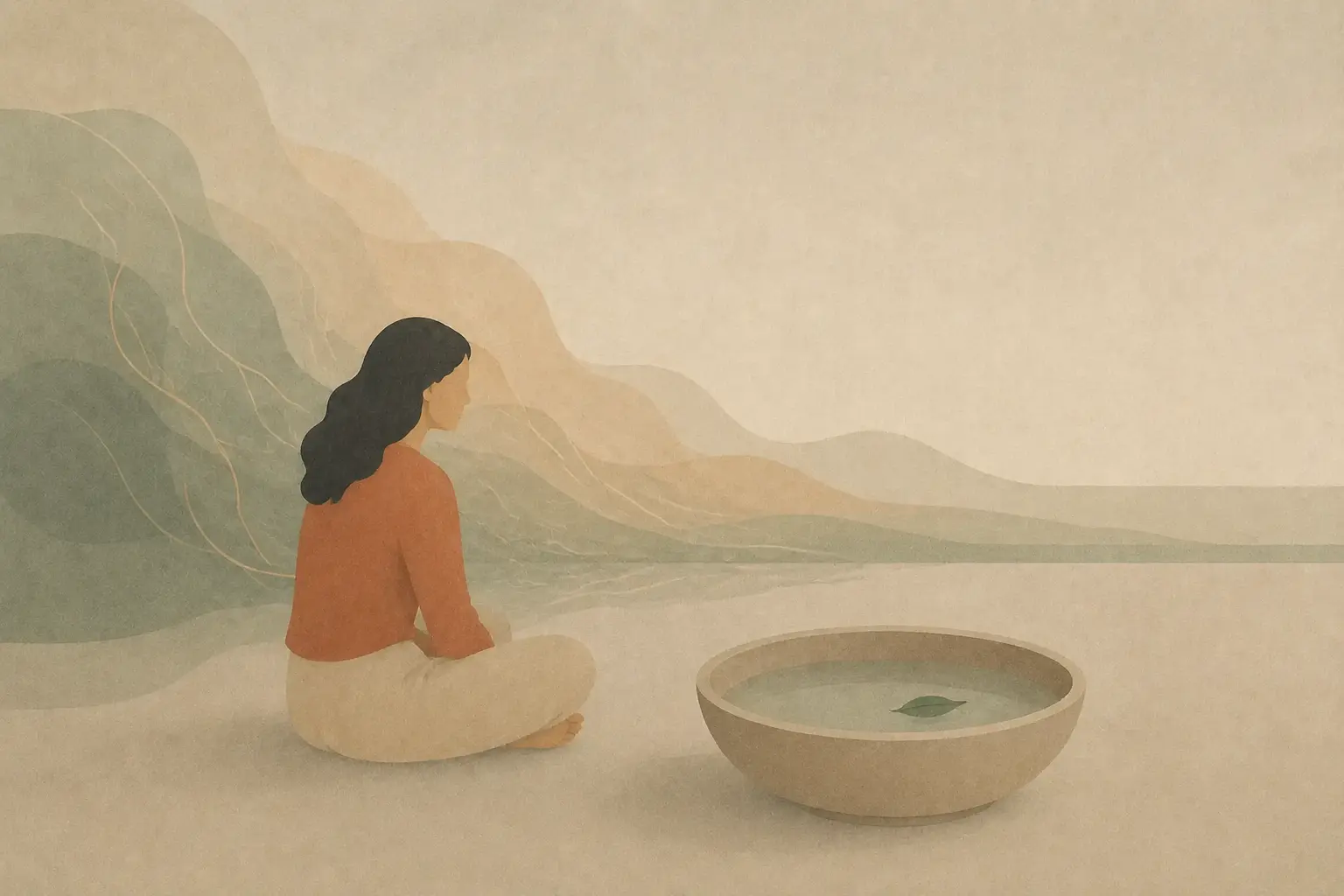
A long, intense period ends. No urgent task or crisis remains. Instead of the expected relief, someone feels uneasy. The quiet house is too quiet; an empty weekend seems meaningless. They want to find a problem or create another rush.
Why can we struggle to trust the calm we sought?
The body may mistake familiarity for safety
After prolonged stress, high arousal becomes familiar. Checking, deciding quickly, and anticipating danger become everyday norms. When circumstances settle, the body may not adjust immediately; low arousal can be experienced as emptiness or vulnerability rather than peace.
This does not mean someone loves drama. The nervous system finds familiar patterns predictable. Familiarity is not always good, but may feel safer than the unknown. Newman and Llera’s (2011) contrast-avoidance model describes a related mechanism: persistent worry may maintain a familiar tension to avoid being caught by a sudden negative emotional shift.
The sea after the storm
In Homer’s Odyssey, Odysseus returns to Ithaca after years of war and travel. Homecoming includes recognition, tests, and adaptation as well as relief. His identity has long developed through struggle. When struggle ends, “Who am I now?” appears.
Similarly, someone who has spent years solving crises, working, or carrying others may experience calm as losing their function. Peace involves forming a sense of self without the noise as well as the noise stopping.
Empty space is not always something missing
A gap in the calendar need not be a fault requiring immediate repair. It may be space where feelings and needs can be heard. Its first sensation may be suppressed fatigue or sadness rather than pleasure. Stopping can bring us into contact with what was postponed.
Calm can therefore be approached gradually. Instead of an entirely empty day, try brief, structured rest intervals; instead of unstructured silence, a quiet walk, music, or bodily activity. The aim is tolerance of lower arousal rather than another performance.
Combining peace with vitality
Calm is not inactivity. Curiosity, play, creating, and relationships can provide vitality without crisis. On noticing “If I’m not busy, I’m not living,” we can ask: What is valuable to me without being urgent?
Peace initially feeling empty does not necessarily mean we are in the wrong place. The body may simply not have learned the new rhythm. If silence is not immediately filled, our own voice may slowly appear where we assumed there was nothing.
Making calm a safe experience
Observing the body during calm can distinguish forms of unease. Does the heart accelerate? Is there boredom? Does a thought appear that an important task was forgotten? Naming it turns a vague emptiness into a more specific experience.
Then establish a bounded interval: ten minutes on the balcony, slowly preparing a drink, or listening to music without a goal. Afterward, another activity remains available. This limit can reduce fear of being trapped in quiet and offer the body a new experience.
Peace also differs from constant happiness. Tiredness, grief, and boredom can appear within calm. They need not mean peace has broken; reduced noise makes these layers audible. Peace may be a wider ground on which feelings can exist without a battle, rather than a sterile space without difficulty.
Getting acquainted with calm
- Which danger does my body anticipate when things settle?
- What judgment about my identity appears when I am not busy?
- Which activity helps me feel alive without a crisis?
These questions may not make peace immediately enjoyable. They help distinguish fatigue, grief, curiosity, or a need for direction within what was called emptiness.
When a tendency to generate a new crisis appears, delay the decision briefly. Rather than starting an unnecessary argument, taking on an unplanned burden, or repeatedly checking the phone, ask, “Will I still want this in half an hour?” Waiting reveals whether the impulse changes by itself. As calm grows familiar, emptiness may gradually become space in which choice is possible.
References
- Homer. (2003). The Odyssey (E. V. Rieu, Trans.; D. C. H. Rieu, rev.). Penguin Classics.
- Newman, M. G., & Llera, S. J. (2011). A novel theory of experiential avoidance in generalized anxiety disorder. Clinical Psychology Review, 31(3), 371–382. https://doi.org/10.1016/j.cpr.2011.01.008