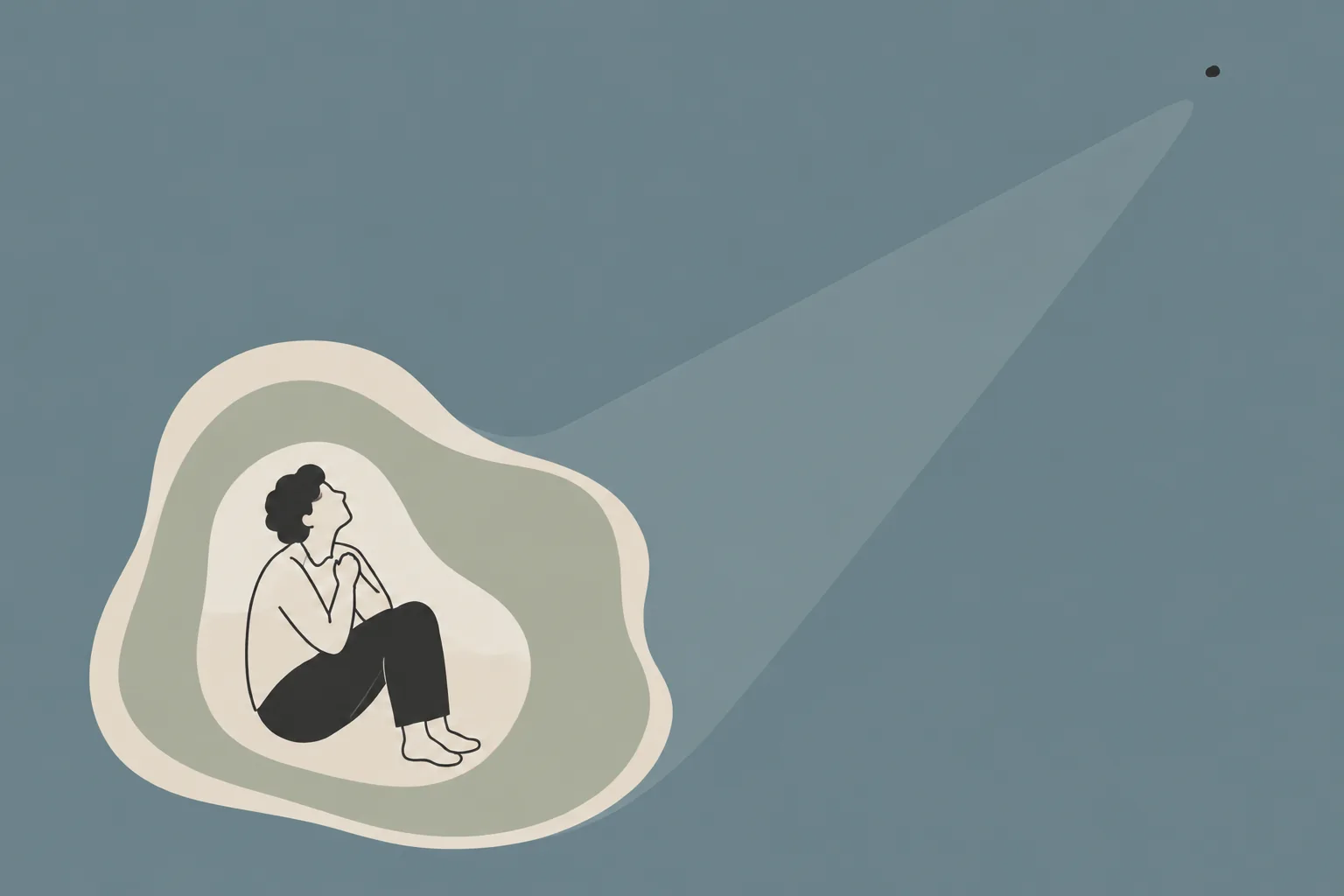
It was Sunday morning. The house was quiet, the coffee hot, and the week had finally become calm. Just then, a thought appeared: “If things are going this well, something is bound to happen.” Their partner noticed the tension in their face and asked what was wrong. They had no concrete answer. There was no visible danger, but their body was already preparing.
Sometimes peace, rather than pain, feels unfamiliar. Struggling to relax when everything is going well is not ingratitude or a pessimistic character flaw. Sometimes a system that has spent a long time on alert simply does not yet find safety convincing.
The central question is: Why does the mind keep looking for approaching trouble when there is no current danger?
How does uncertainty feed anxiety?
The brain cannot know the future with certainty; it makes predictions from past experience and present cues. Grupe and Nitschke’s review of anxiety describes how uncertainty can influence threat anticipation, attention, and decision-making. Before saying “Something bad will happen,” an anxious mind often says, “I don’t know what will happen, and I need to be ready.”
After prolonged unpredictability, a person may scan good moments for whatever will spoil them. If calm was previously followed by arguments, loss, illness, or emotional withdrawal, the mind may have learned a pattern: “Good things don’t last.” That expectation need not be accurate today, but the body continues preparing in a way that once helped.
This is not only about childhood. Financial uncertainty, heavy workloads, traumatic events, constant news exposure, and a relationship that is currently unsafe can also sustain vigilance. Locating anxiety solely inside the individual overlooks actual living conditions.
Why does preparing offer a temporary sense of control?
“If I worry in advance, it will hurt less” can create a sense of control over an uncertain future. Repeatedly considering bad possibilities may feel like preparation. But if there is no clear point at which preparation is complete, the mind keeps running the same scenario.
Allostatic load describes the cumulative effects of prolonged stress on the body. McEwen’s work explains how stress systems that continually adapt can generate physical costs over time. This does not mean every anxious feeling damages the brain or body. The emphasis is on the cost of sustained activation without rest and recovery.
Anxiety sometimes signals a real need; it is not an enemy that must be silenced entirely. But if it keeps rehearsing the same danger after necessary preparations are complete, it may be exhausting us more than protecting us.
Cassandra’s curse
In Greek mythology, Cassandra sees the future, but no one believes her. Her tragedy is knowing the danger and being unable to make others hear it. Everyday anxiety often resembles the reverse: the mind does not see the future, yet makes possibilities feel certain.
This distinction matters. A thought’s intensity, vividness, and persistence do not make it a prophecy. “What if it happens?” does not mean “It will happen.”
The myth offers another reflection: someone who constantly sounds an alarm may eventually stop being heard. Rather than simply suppressing anxiety, it helps to distinguish two things: what is a real risk that needs addressing now, and what is an expectation carried over from the past?
Returning to the body before arguing with the mind
When alarm rises, debating with our thoughts does not always help. It may be more effective to first remind the body of the present moment:
- Notice your feet touching the floor.
- Let your out-breath become a little longer.
- Name five objects you can see in the room.
- Deliberately relax your shoulders and jaw.
The aim is not to force anxiety away, but to give the nervous system the information “I am here, now.” Then two questions can follow:
- What concrete evidence do I have of danger right now?
- How much of this feeling belongs to an expectation I learned in the past?
No one can guarantee that things will never go wrong. A more realistic reassurance is: “Something good is happening now. I don’t know whether it will last forever. If things change, I can turn to my own resources and to support.”
Becoming accustomed to peace is also a skill. Sometimes trusting what is good begins with staying a few minutes longer in what is good today, rather than controlling the future.
References
- Grupe, D. W., & Nitschke, J. B. (2013). Uncertainty and anticipation in anxiety: An integrated neurobiological and psychological perspective. Nature Reviews Neuroscience, 14, 488–501. https://doi.org/10.1038/nrn3524
- McEwen, B. S. (2007). Physiology and neurobiology of stress and adaptation: Central role of the brain. Physiological Reviews, 87(3), 873–904. https://doi.org/10.1152/physrev.00041.2006
- Carleton, R. N. (2016). Into the unknown: A review and synthesis of contemporary models involving uncertainty. Journal of Anxiety Disorders, 39, 30–43. https://doi.org/10.1016/j.janxdis.2016.02.007
- Aeschylus. Agamemnon. (The story of Cassandra.)