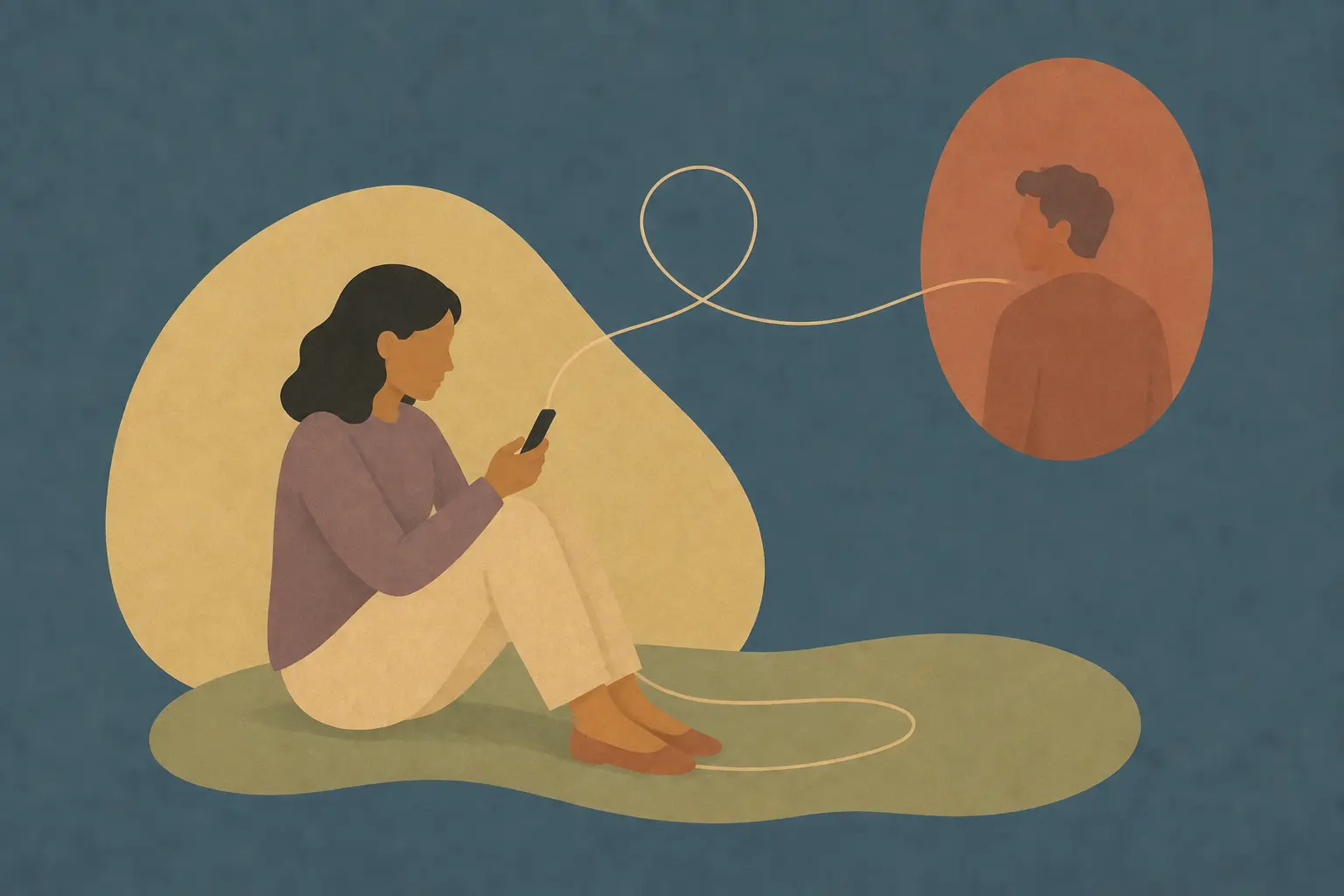
When they pick up the phone, they have already decided not to do it. A few minutes later, they open their ex’s profile anyway. Any new photos? Who have they followed? Do they look happy? Checking brings a moment of relief. Soon afterward, their chest tightens as though the breakup has just happened again.
Checking an ex’s profile is often explained as “I still love them.” Love or longing may be part of it, but the behavior does not simply show how intense the feeling is. Trying to reduce uncertainty, habit, comparison, searching for hope, and the apparent accessibility of a lost bond may also sustain the cycle.
A breakup does not necessarily end online
In the past, new information about an ex usually arrived by chance through mutual acquaintances. Today, their daily life can be a few taps away. The relationship may end while the flow of information continues. Physical absence and digital presence coexist.
Tara Marshall’s research on monitoring former partners through Facebook found associations between profile surveillance and greater breakup distress, longing, and negative feelings, alongside less personal growth. The study alone cannot establish cause and effect. People in greater pain may check more often, and checking may make it harder for the pain to settle. The two directions likely reinforce each other.
Why doesn’t the information bring relief?
Before checking, the mind experiences uncertainty: “I wonder what they’re doing.” Opening the profile briefly reduces that uncertainty. Even without finding anything new, someone can feel “I checked, so now I know.” This brief relief teaches them to repeat the behavior.
But social media does not provide certainty. A smiling photo is not proof of a happy life, a new follow is not proof of infidelity, and an absence of posts is not proof of sadness. Every visit generates fresh interpretations. People enter looking for an answer and leave with more questions.
Why did Orpheus look back?
As Orpheus leads Eurydice out of the underworld, he must follow one condition: do not look back before reaching the surface. Close to the end, he cannot bear his doubt and turns. At that moment, he loses Eurydice again.
The story does not suggest that looking at an ex is morally wrong. It shows how powerful the need for certainty can be within loss. Orpheus looks because he wants to know she is still there, not because he does not love her. Yet seeing makes him experience the loss again instead of reversing it.
Sometimes we are looking for our place, not our ex
Checking a profile carries questions beyond “How are they?” It can also ask “How are they without me?” “Has someone replaced me?” and “How much did our relationship matter to them?” Trying to infer our worth from another person’s posts ties us to a measure we cannot control.
Particularly when a breakup has shaken someone’s identity, watching an ex’s life maintains contact with the shared story. Even a painful, familiar bond may feel safer than a wholly uncertain future.
Understanding the cycle instead of simply banning the behavior
“Just control yourself” is often insufficient. First, it can help to notice when the behavior appears: when lonely, at night, after seeing someone new, or when feeling worthless? You can note what you expect just before checking and what you feel afterward.
Turning off notifications, muting an account, or making access less immediate is not weakness. It means changing the environment around a repeatedly triggered habit. Shared children, work, or necessary contact may make complete separation impossible. In that case, it helps to distinguish necessary digital contact from contact that keeps the wound open.
The answer sought on an ex’s profile is often not there. Healing need not mean never wondering again. It can mean no longer having to reenact the loss whenever curiosity appears. The urge to look back is human. We can still notice where each look takes us.
References
- Marshall, T. C. (2012). Facebook surveillance of former romantic partners: Associations with postbreakup recovery and personal growth. Cyberpsychology, Behavior, and Social Networking, 15(10), 521–526. https://doi.org/10.1089/cyber.2012.0125
- Sbarra, D. A., & Emery, R. E. (2005). The emotional sequelae of nonmarital relationship dissolution: Analysis of change and intraindividual variability over time. Personal Relationships, 12(2), 213–232. https://doi.org/10.1111/j.1350-4126.2005.00112.x
- Slotter, E. B., Gardner, W. L., & Finkel, E. J. (2010). Who am I without you? The influence of romantic breakup on the self-concept. Personality and Social Psychology Bulletin, 36(2), 147–160. https://doi.org/10.1177/0146167209352250