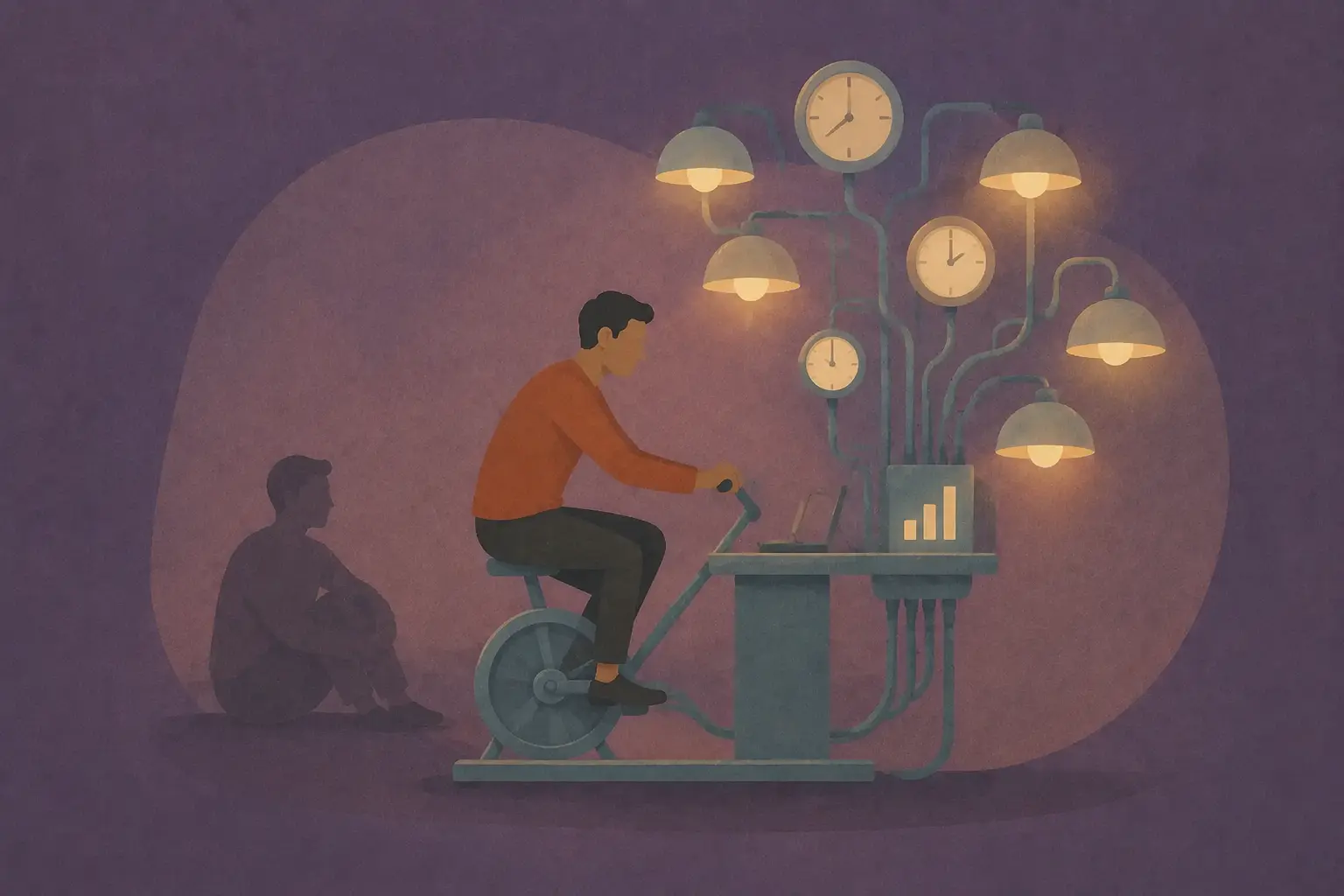
As soon as one task ends, another opens. They cannot walk without headphones or eat without a screen. “I’m a busy person,” they say, yet a free hour creates anxiety. Busyness has become a refuge as well as a schedule.
When does doing become a way of avoiding living?
Busyness can postpone emotion
Work and responsibilities may be real. Constant movement can still have another function: delaying contact with sadness, loneliness, indecision, or meaninglessness. Completed tasks provide control and competence, while inner uncertainty offers no clear finish line.
Avoidance relieves in the short term. But without any space for emotion, someone seeks more stimulation and tasks. Rest feels guilty and quiet threatening. Busyness can sustain over time the very unease it relieves immediately. Hayes and colleagues’ (1996) “experiential avoidance” describes this narrowing of life through attempts to stay away from unwanted inner experiences.
Pascal’s idea of diversion
Blaise Pascal writes that humans continually seek diversion to avoid being alone with mortality and vulnerability. Notifications, meetings, and uninterrupted content may have replaced the hunting and court entertainment of his time. The tools change, but avoiding questions that appear in solitude remains familiar.
This perspective does not devalue every activity. It distinguishes moving toward what we do from using it to flee something. The same work may be meaningful participation one day and emotional shelter another.
Why is stopping hard?
In Timothy Wilson and colleagues’ (2014) research, participants found being alone with their thoughts harder than expected. Empty space does not automatically bring mental peace; the mind may generate problems and scan past and future. This points toward attention needing practice rather than humans being unsuited to quiet.
Try five minutes sitting without a phone, naming what appears without solving it: “plan,” “anxiety,” “sadness,” “boredom.” Then choose one actual need. If intense feelings arise, shorten the period and seek safe support.
Making busyness a choice
The aim is not abandoning work or treating slowness as morally superior. Ask: Am I choosing this activity, or is it directing me away from myself? Brief transitions, asking why we do a task, and giving rest a legitimate place in the calendar can reduce automaticity.
Every destination reached while fleeing ourselves may be crowded, yet we may be absent from it. Stopping will not provide all answers. It can open the first space in which the avoided question becomes audible.
Seeing the cost of intensity
Busyness costs more than fatigue. Continually divided attention can make relationships shallow, achievements flat, and decisions automatic. Doing much, someone may struggle to distinguish actions serving values from actions escaping anxiety.
For a week, mark major activities as “necessary,” “valued,” “escape,” or “mixed.” The same behavior can serve different functions on different days. Work may be necessary and meaningful, while on another evening it avoids loneliness. The aim is to see patterns rather than assign blame.
Freed time need not be immediately filled with self-improvement. If rest becomes another project to perform perfectly, avoidance changes form but continues. Sometimes being with ourselves means carrying an unresolved question for a few minutes and still preparing dinner.
Understanding busyness’s function
- Which feeling or thought would I face if I did not do this task?
- How much of my busyness is necessity, and how much automatic avoidance?
- What actually happens if I leave five minutes unfilled?
Recognizing the function does not require abandoning busyness entirely. It makes work, rest, and escape distinct enough for choice.
References
- Hayes, S. C., Wilson, K. G., Gifford, E. V., Follette, V. M., & Strosahl, K. (1996). Experiential avoidance and behavioral disorders. Journal of Consulting and Clinical Psychology, 64(6), 1152–1168. https://doi.org/10.1037/0022-006X.64.6.1152
- Pascal, B. (1995). Pensées (A. J. Krailsheimer, Trans.). Penguin Classics.
- Wilson, T. D., Reinhard, D. A., Westgate, E. C., Gilbert, D. T., Ellerbeck, N., Hahn, C., Brown, C. L., & Shaked, A. (2014). Just think: The challenges of the disengaged mind. Science, 345(6192), 75–77. https://doi.org/10.1126/science.1250830