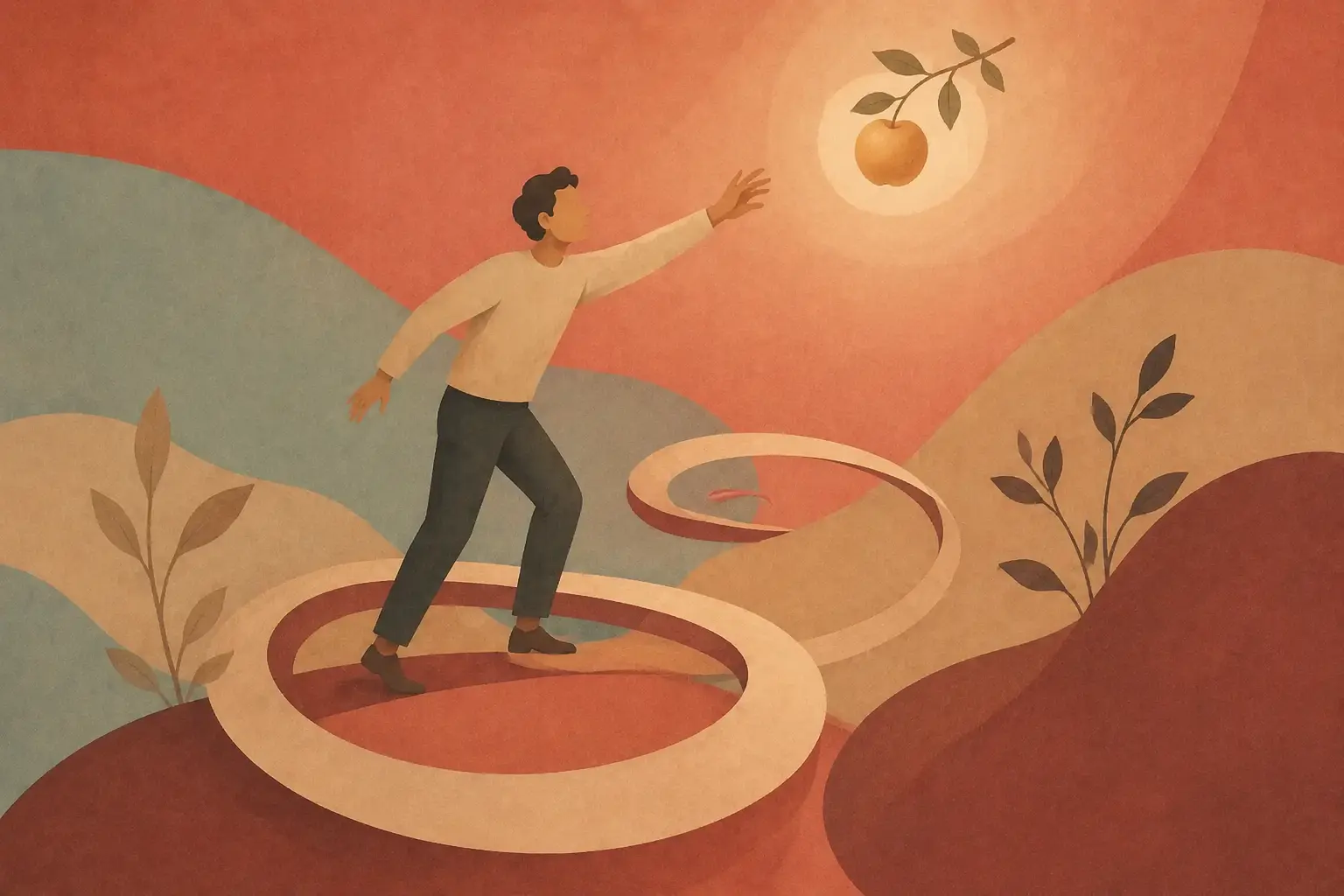
A distant goal feels captivating. Someone imagines the day they will reach it and fills in the details. As it comes closer, an odd unease appears. New flaws become visible, other options attract attention, or the eventual pleasure lasts less time than expected.
Why does desire not end in fulfillment?
Wanting and liking are different
Kent Berridge and Terry Robinson’s (2016) neuroscience research suggests that “wanting” and “liking” are not identical processes. Motivation toward something can be intense without pleasure increasing to the same degree when it is obtained. Expectations, cues, and potential reward can strongly mobilize behavior, while the experience itself is quieter.
This helps explain why we may want something passionately and feel surprised after getting it. Desire often attaches to a promise rather than the object alone: becoming complete, seen, powerful, or someone new.
Tantalus’s unreachable fruit
In Homer’s Odyssey, Odysseus sees Tantalus in the underworld standing in water that retreats when he bends to drink, beneath fruit whose branches move away when he reaches. His punishment is more than hunger: the object remains close, and that closeness keeps wanting alive. Fulfillment never tests desire against its fantasy.
In everyday life, an unavailable person, job, or status can similarly become perfect in the mind. Distance lets imagination fill the gaps. Nearness introduces reality: every object has limits, and every choice involves losses.
Which need lies beneath desire?
Translating desire may be more useful than suppressing it. After “I want this,” ask “How do I hope it will make me feel?” Respected, connected, alive, safe? More than one route may meet the same need.
This inquiry does not devalue wanting. It removes a burden the object cannot carry. No relationship can resolve all loneliness, no achievement every feeling of inadequacy, and no purchase the lasting need for novelty on its own.
Making room for fulfillment too
Some people become so accustomed to wanting that they mistake the quieter feeling of having for a lack of excitement. Satisfaction is often less dramatic than desire’s rise. Relating to what is obtained—using it, sharing it, seeing its limits, and incorporating it into daily life—takes time. Kringelbach and Berridge’s (2009) review of pleasure neuroscience also describes pleasure as relying on more restricted and fragile circuitry than wanting.
Desire provides direction without always providing a final answer. If goals keep receding like Tantalus’s fruit, the difficulty may not lie only in the target. Perhaps we avoid the limitations encountered in closeness, the paths a choice closes, or the quiet of ordinary happiness.
Approaching desire without immediately obeying it
A wish does not have to be fulfilled immediately simply because it exists. Desire may rise and fall like a wave. A short delay, particularly around shopping, digital content, or continual approval-seeking, can widen the space between wanting and choosing. During that time, bodily arousal, the imagined promise, and the actual need can be observed separately.
Three written sentences can test desire without suppressing it: “What do I imagine will happen if I get this?” “Which earlier objects carried this promise?” “What other small ways could meet this need today?” If a purchase promises vitality, for example, explore how the need relates to movement, creativity, or social contact.
A deliberate slowing is useful after fulfillment too. Seeing the object’s or goal’s actual features, limits, and everyday place means moving from fantasy into relationship. If life seems colorless when wanting subsides, the issue may be that our energy has become attached only to “the next thing,” rather than simple insatiability.
The question beneath desire
- Do I want the object, or the version of myself it represents?
- Which qualities am I idealizing because it is distant?
- How much time do I allow for fulfillment’s quiet satisfaction?
Examining desire does not mean being ashamed of it. Placing it within a wider map of needs allows wanting and living to stop competing.
References
- Berridge, K. C., & Robinson, T. E. (2016). Liking, wanting, and the incentive-sensitization theory of addiction. American Psychologist, 71(8), 670–679. https://doi.org/10.1037/amp0000059
- Homer. (2003). The Odyssey (E. V. Rieu, Trans.; D. C. H. Rieu, rev.). Penguin Classics.
- Kringelbach, M. L., & Berridge, K. C. (2009). Towards a functional neuroanatomy of pleasure and happiness. Trends in Cognitive Sciences, 13(11), 479–487. https://doi.org/10.1016/j.tics.2009.08.006