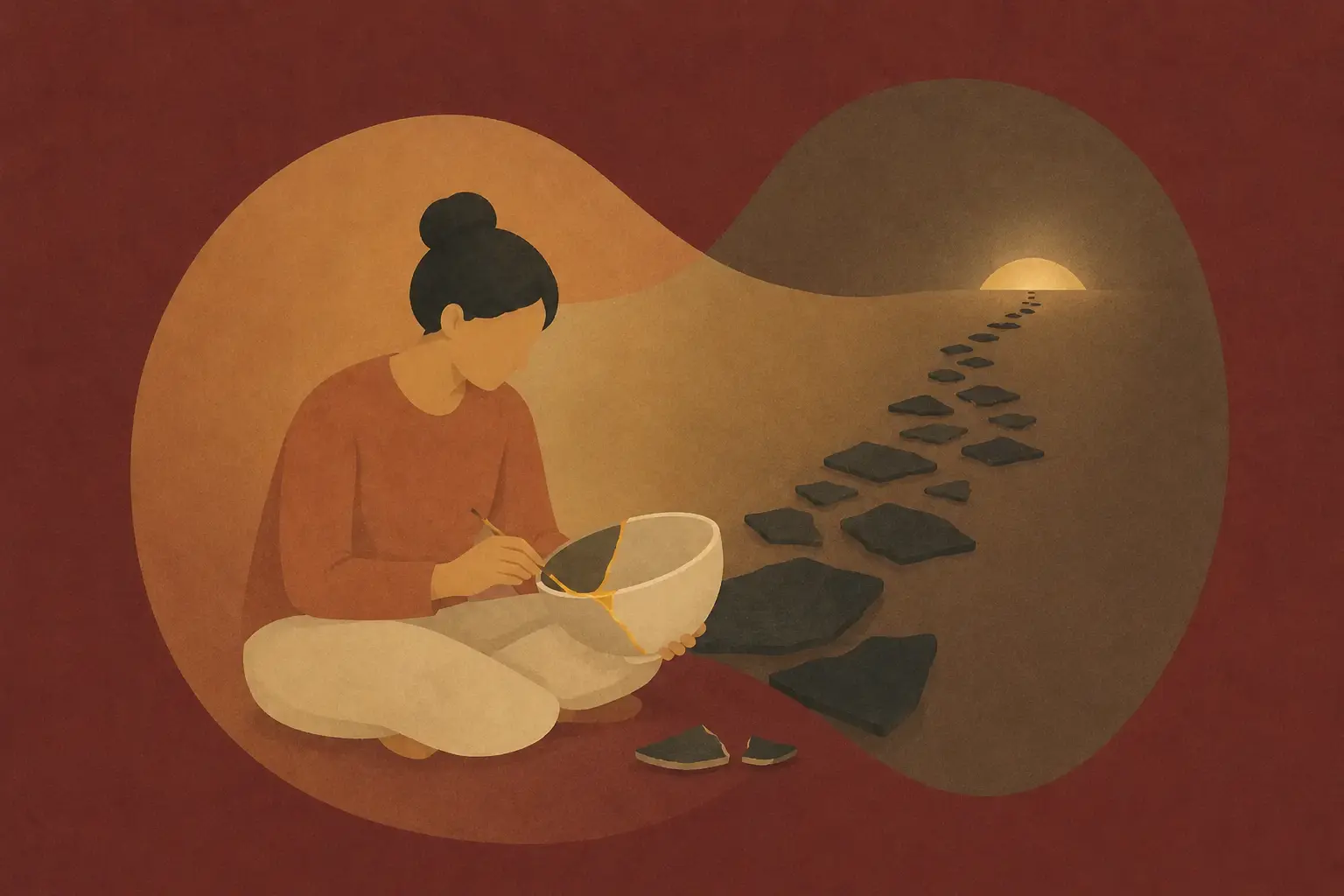
The same difficulty can feel completely different on different days. Knowing why they are striving, someone can endure fatigue. When the experience seems connected to nothing, even a small burden feels crushing.
Is pain’s weight shaped by the meaning we give an event as well as the event itself?
The mind seeks explanation
A large gap between expectations and events can disrupt the world’s intelligibility. When assumptions such as “Good things happen to good people” or “Hard work pays off” fail, we face both the event and the collapse of an order of meaning.
Crystal Park’s (2010) review of meaning-making literature describes attempts to reconcile stressful events with broader beliefs and goals. Yet the belief that every pain contains a ready-made message is dangerous. “You must learn something from this” can leave a suffering person alone.
Sisyphus and the unanswered stone
Sisyphus repeatedly pushes the rock uphill, only to have the outcome undone. For Camus, the central issue is humanity’s desire for meaning before the world’s silence. His reading does not provide a beautiful reason for pain; it asks how to live without an answer.
This distinction matters. Finding meaning does not declare that what happened was necessary or good. Sometimes meaning develops in our subsequent response rather than within the event. Injustice can remain injustice while a person chooses solidarity, boundaries, or a valued life.
From “Why?” to “What now?”
“Why did this happen to me?” sometimes leads to a real explanation and sometimes remains unanswered. When the mind repeats an unanswerable question, “What matters to me now?” can open another space for action.
This is not a rush toward positivity. Loss and anger need acknowledgment first. Then small sources of meaning may appear: contacting someone, maintaining routines, expressing what happened, or helping another person not face similar pain alone.
Meaning is built, not imposed
Viktor Frankl emphasizes that people may find room in their attitude toward circumstances even without power over the circumstances themselves. This can offer hope, but must not be used to burden someone in pain with further responsibility. Meaning is not homework; it is a relationship that may emerge with time.
Pain need not have a purpose. A person can still live without letting it define their entire identity and future. Sometimes what lightens the burden is “I know what I want to preserve despite this,” rather than “There was a good reason for it.”
Not rushing the search
A major lesson need not follow immediately after a shattering event. Safety, rest, grief, or practical support may come first. Meaning needing time does not indicate inadequacy. Some experiences may remain simply painful for a long while.
Well-intended comments such as “Everything happens for a reason” or “It made you stronger” can obscure harm. More supportive is allowing people to develop meaning at their own pace. Before asking what the experience offers them, we need to be able to say, “I see how hard this is.”
Meaning need not arrive as one grand purpose. Daily care, maintaining a relationship, naming injustice, or meeting a small responsibility can also provide it. Small commitments carry life on days without a large answer. Meaning may be a direction built through repeated actions rather than a discovered explanation.
Remaining with unanswered questions
- Without declaring this event good, how do I want to respond?
- What single value do I want to protect today?
- Without a grand answer, which small commitment could carry me?
Meaning-making cannot always be undertaken alone. A relationship that bears witness can help hold experience before an answer is ready. Not every question must be solved; some become more bearable with company.
References
- Camus, A. (1991). The myth of Sisyphus and other essays (J. O’Brien, Trans.). Vintage.
- Frankl, V. E. (2006). Man’s search for meaning. Beacon Press.
- Park, C. L. (2010). Making sense of the meaning literature. Psychological Bulletin, 136(2), 257–301. https://doi.org/10.1037/a0018301