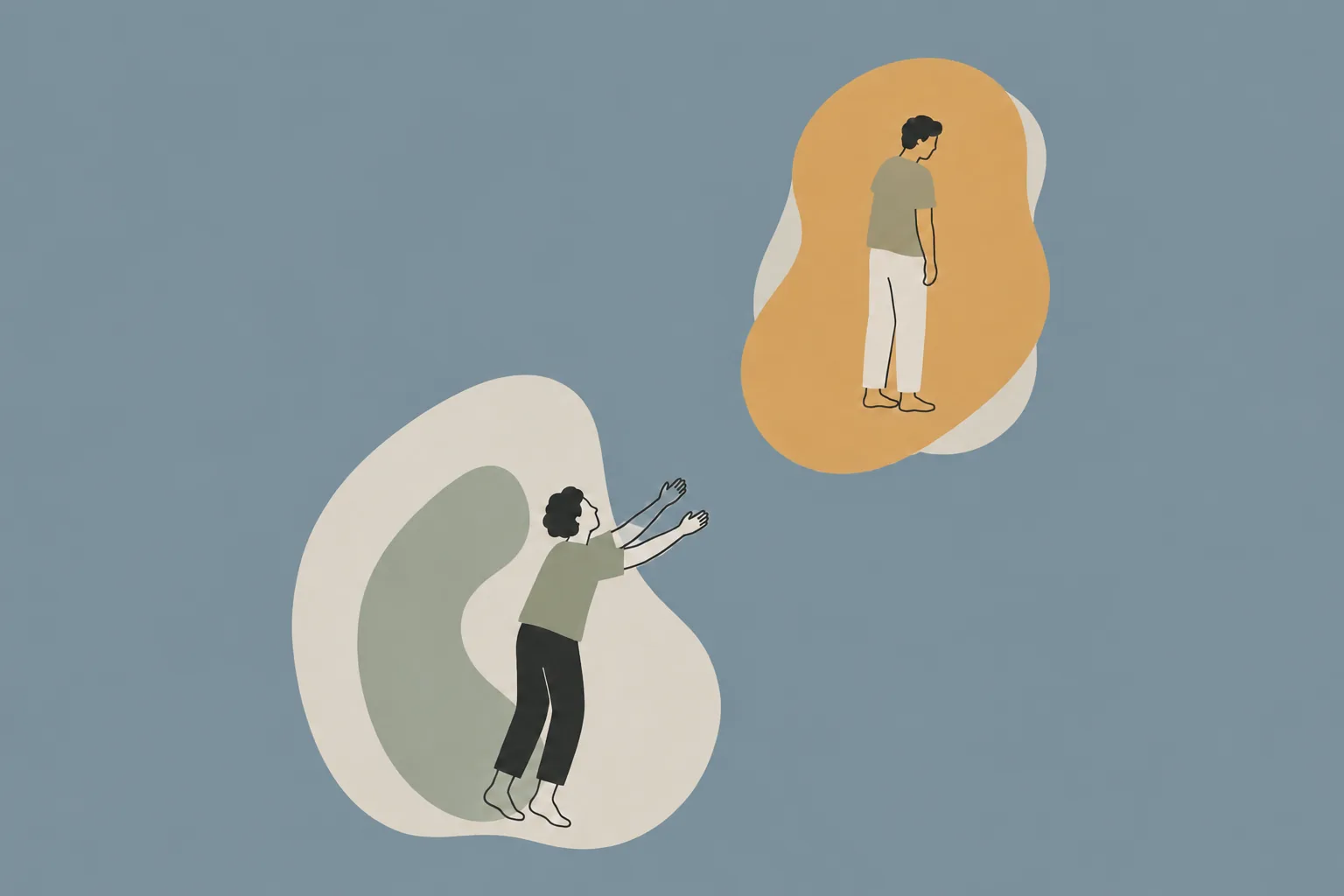
There had been no reply for six hours. All day, they kept their phone face up on the table. Each time the screen lit up, their attention broke. When a brief “How are you?” finally arrived that evening, all the tension dissolved for a few seconds. Yet the message clarified nothing about the relationship; it simply started the uncertainty again.
Sometimes the need to win someone’s love overtakes the question of whether that person is actually good for us. The less interest they show, the more we think about them; the further they pull away, the harder we try. From within, this effort can feel like completing something: “If they would just truly choose me once, the missing part inside me would be repaired.”
But the person is not always the only thing we are pursuing. We may be pursuing a sense of our own worth that we believe their choice would prove.
Why does uncertainty occupy the mind?
Clear reciprocity gives us a basis for evaluating a relationship. Attention that is warm one day and distant the next forces the mind to keep guessing. We begin watching for the next sign of closeness.
Research on reward learning shows that rewards that differ from expectations provide a powerful learning signal. It would be wrong to translate this mechanism directly into “dopamine addiction” in romantic relationships. Still, it helps explain why inconsistent attention may occupy the mind more than a clear answer: uncertainty holds attention on a possibility.
In a small fMRI study of romantic rejection, Fisher and colleagues examined responses to photographs of former partners among participants who had recently been left but remained intensely in love. They observed activity in some brain regions associated with reward and motivation. This does not mean “unrequited love is an addiction.” It suggests that ending a relationship does not instantly switch off motivation and attachment.
Why does past effort make giving up harder?
Time spent on a relationship, shared dreams, and sacrifices can strengthen the thought “If I give up now, it will all have been for nothing.” Rusbult’s investment model suggests that commitment is related not only to relationship satisfaction, but also to investments and how a person perceives other options.
Sometimes, then, a person is trying to salvage past effort rather than the relationship as it exists today. That past investment is real, but it does not create an obligation to keep making the same investment in the future.
Echo’s loss of her own voice
In Ovid’s story of Echo and Narcissus, Echo cannot form sentences of her own; she repeats another person’s last words. As she tries to exist through Narcissus’s attention, her own voice becomes fainter.
Myth does not explain contemporary relationships, but it can reflect this experience: when “Why won’t they choose me?” takes up all the space, a person’s own voice can become inaudible. A more basic question falls into the background: “Am I actually being chosen in this relationship?”
Waiting for just one person’s gaze in order to feel seen places all our self-worth in their hands. Winning their love may offer brief relief, but it cannot, on its own, resolve a much older doubt about ourselves.
Effort is not the same as reciprocity
There is nothing wrong with working at a relationship. Intimacy sometimes requires patience and repair. But effort has meaning when both people can turn toward the relationship. If only one person calls, explains, waits, and repairs, the experience can eventually become an endless test rather than love.
“I understand why they are like this” can sometimes become another way of postponing our own needs. Understanding another person’s past and distance does not oblige us to suspend our needs indefinitely. Empathy is not another name for abandoning ourselves.
These questions may make the cycle easier to see:
- When I am in contact with this person, do I feel calmer, or more driven to prove myself?
- If their interest were consistent, would I still want them in the same way?
- What old doubt about myself does their choosing me seem to promise to silence?
If your need is to feel valued, enough, or safe from abandonment, that need is real. But its answer does not have to lie with this person alone. A healthy bond grows through two people choosing each other clearly and consistently, rather than one person having to prove their worth again and again.
References
- Fisher, H. E., Brown, L. L., Aron, A., Strong, G., & Mashek, D. (2010). Reward, addiction, and emotion regulation systems associated with rejection in love. Journal of Neurophysiology, 104(1), 51–60. https://doi.org/10.1152/jn.00784.2009
- Rusbult, C. E., Martz, J. M., & Agnew, C. R. (1998). The investment model scale: Measuring commitment level, satisfaction level, quality of alternatives, and investment size. Personal Relationships, 5(4), 357–387. https://doi.org/10.1111/j.1475-6811.1998.tb00177.x
- Schultz, W. (2016). Dopamine reward prediction-error signalling: A two-component response. Nature Reviews Neuroscience, 17, 183–195. https://doi.org/10.1038/nrn.2015.26
- Ovid. Metamorphoses, Book 3. (Echo and Narcissus.)